
Key Moments
Issuer and Account Requirement
Cashier's checks come from banks and often require accounts, while money orders are widely available without one.Payment Limits and Use Cases
Money orders cap at $1,000, suitable for smaller payments; cashier's checks have no upper limit, ideal for large transactions.Cost and Privacy
Money orders are cheaper and keep bank details private; cashier's checks are costlier and may reveal bank info.Security and Fraud Risks
Cashier's checks offer stronger fraud protection; both need verification as money orders commonly appear in scams.When a personal check will not cut it, two guaranteed options usually come up: a cashier’s check and a money order. Both are prepaid, both are safer than a personal check, and both are handy when you cannot or would rather not pay in cash. But they are not interchangeable. The right one depends on how much you are paying, who you are paying, and whether you have a bank account.
Here is a straight comparison, plus clear guidance on which to reach for. This is part of our types of checks explainer series.
Quick facts
| Cashier’s check | Money order | |
|---|---|---|
| Issued by | Bank or credit union | Post office, retailers, banks, some stores |
| Backed by | The bank’s own funds | Prepaid at purchase |
| Typical limit | No fixed upper limit | $1,000 per order (domestic) |
| Typical cost | About $0 to $20 | About $1 to $5 |
| Bank account needed | Usually yes | No |
| Shows your bank details | Sometimes | No |
| Best for | Large payments | Smaller payments |
Costs and limits vary by issuer and location. Confirm before you buy.

What each one is
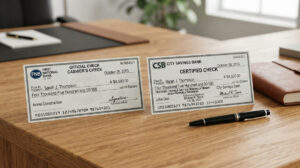
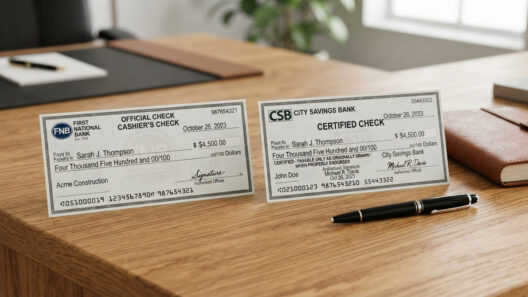
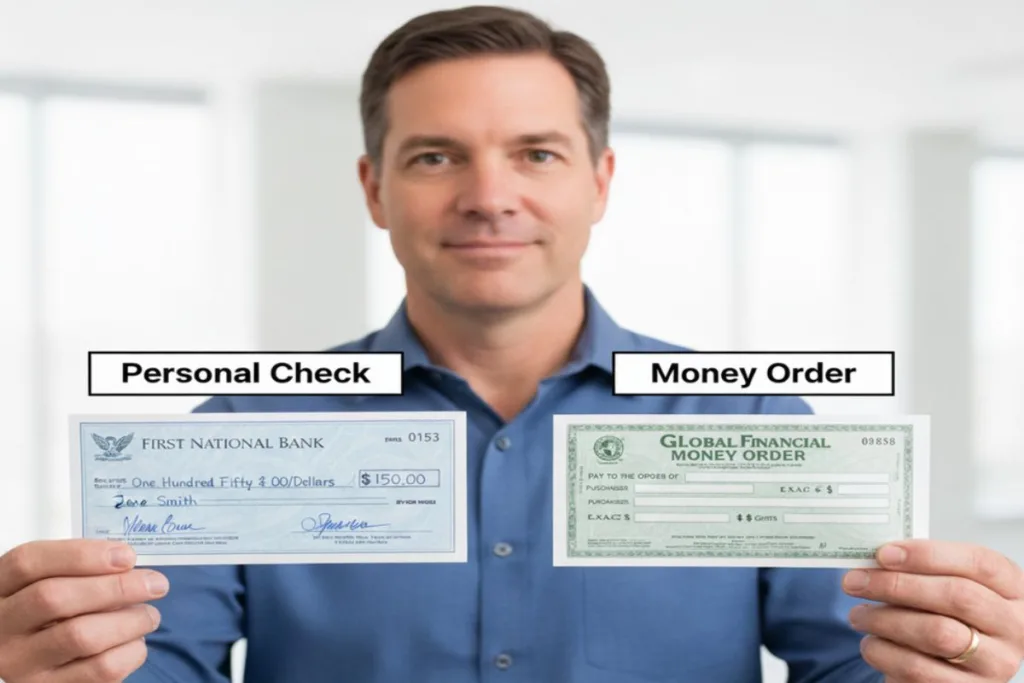
A cashier’s check is written by a bank or credit union and drawn on the bank’s own account. You hand over the amount up front, from your account or in cash, and the bank issues a check signed by a teller or officer. Because the bank guarantees it, the recipient can trust the funds are there. There is generally no upper limit as long as you can cover the amount.
A money order is a prepaid slip you buy with cash or a debit card. You pay the face value plus a small fee and receive a printed order that you fill out to a named recipient. It cannot bounce because it is paid for at the moment of purchase. Domestic money orders max out at $1,000 each.
The differences that matter
Where you get them. A cashier’s check comes only from a bank or credit union, and usually you need an account there. A money order is far easier to grab: post offices, grocery stores, pharmacies, convenience stores, and check cashing outlets all sell them, no account required.
How much they cover. This is the big one. A money order is capped at $1,000 per order, so it does not suit large payments. A cashier’s check has no fixed ceiling, which is why it is the standard for cars, down payments, and closings. If you tried to cover a large sum with money orders, you would need to buy many of them.
What they cost. Money orders are cheap. The U.S. Postal Service charges about $2.35 for orders up to $500 and about $3.40 for $500.01 to $1,000, and some retailers charge as little as $1. A cashier’s check usually runs higher, often up to around $10 to $20, though some online banks issue them free.
Privacy. A money order does not carry your bank account details, which makes it appealing for mailing payments or paying someone you do not know well. A cashier’s check may show some of your information.
Security. Both are more secure than a personal check. A cashier’s check is generally considered the stronger of the two because it is backed by the bank and carries more anti fraud features. Money orders are secure but are more commonly used in scams, so extra care pays off.
Which should you use?
Match the tool to the job:
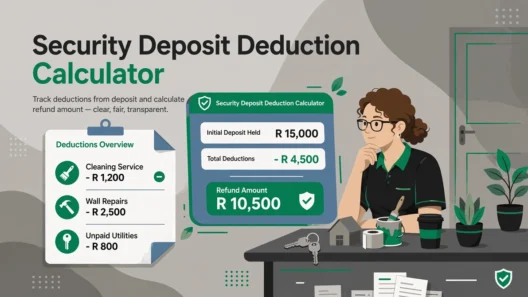
- Security deposit or first month’s rent: either works, but many landlords specify one. A cashier’s check signals a banking relationship; a money order works if you are unbanked. See our security deposit guide for what a landlord can require.
- Buying a car or a big ticket item: a cashier’s check, since it clears the $1,000 money order cap and carries a stronger guarantee.
- Closing on a home: a cashier’s check is standard for closing costs. Read closing on a house for how the funds fit into the process.
- Mailing a smaller payment: a money order keeps your bank details off the paper.
- Court fees, fines, or government payments: many agencies require one specific form, so check the payee’s instructions first.
- No bank account: a money order, which needs no account at all.
How to get each
Cashier’s check: Visit your bank or credit union, or order online if your bank allows it. Bring the exact amount and the recipient’s name. The bank pulls the funds or takes cash, prints the check, and gives you a receipt. Keep that receipt.
Money order: Go to a post office, retailer, or bank that sells them. Pay the amount plus the fee in cash or by debit card, then fill in the recipient and your details on the printed order. Keep the stub with the serial number.
If it is lost or stolen
Neither is as easy to replace as you might hope, so store the receipt.
For a cashier’s check, contact the issuing bank, file a claim, and expect to wait. Some banks require an indemnity bond and a waiting period that can stretch up to around 90 days before they reissue or refund.
For a money order, contact the issuer with your receipt. Confirming a loss can take up to about 30 days, and a full investigation can take longer. A fee usually applies to replace it.
Watch for fraud
A frequent scam sends you a real looking cashier’s check or money order for more than you are owed, then asks you to deposit it and send back the difference. Days later the item is exposed as fake and the bank claws back the full amount, leaving you short.
Protect yourself two ways. Verify the item by calling the issuing bank or company using a number you look up independently, not one printed on the check. And never wire or send back money to someone who overpaid you. Our piece on fake job postings and payment scams covers how these setups usually unfold.
Frequently asked questions
Which is safer, a cashier’s check or a money order? A cashier’s check is generally considered safer for large amounts because the bank backs it and it has more security features. A money order is secure for smaller amounts but turns up in scams more often, so verify before depositing.
Can I get a cashier’s check without a bank account? Usually you need an account, but some banks or credit unions will issue one in exchange for cash plus a fee. A money order needs no account at all.
What is the maximum for each? A domestic money order is capped at $1,000 per order. A cashier’s check has no fixed upper limit as long as you can cover it.
Do they expire? Money orders generally do not expire, though some issuers charge a service fee after a period of non use. Cashier’s checks may be subject to state unclaimed property rules after a long time, so cash them promptly.
Which is cheaper? A money order, usually $1 to $5, is cheaper than a cashier’s check, which can run up to around $20. But a money order only covers up to $1,000.
Lead Paragraph publishes general information, not financial or legal advice. Fees, limits, and policies vary by issuer and location and can change, so confirm details before you make a payment.