
Key Moments
Differences Between Check Types
Each check type varies by who guarantees funds, cost, and typical use cases.When to Use Each Check Type
Choosing the right check depends on amount, payee trust, and payment security needs.Risks and Protections Against Fraud
Counterfeit cashier’s checks and money orders can cause losses, so always verify.Money Orders Are Convenient Alternatives
Money orders are prepaid, don’t require bank accounts, and suit smaller or unbanked payments.Most payments happen by tap, swipe, or app now, but paper still shows up at the moments that matter most: a security deposit, a car sale, a mortgage closing, a court fee. When a personal check will not do, and cash is risky, you need to know which piece of paper to reach for.
This guide breaks down the main types of checks and check-like payments, how each one works, roughly what they cost, and when each is the right call. It is the hub for our deeper explainers on cashier’s checks vs. money orders and the rest of the payments series.
Types of checks at a glance
| Type | Who guarantees it | Typical limit | Rough cost | Best for |
|---|---|---|---|---|
| Personal check | You (your account balance) | Your available funds | Free (part of a checkbook) | Bills, rent, gifts, low risk payments |
| Business check | The business account | Account balance | Cost of check stock | Company expenses and payroll |
| Certified check | You, but bank verifies and sets aside the funds | Your available funds | Often under $15 | Payments that need proof funds exist |
| Cashier’s check | The bank (its own funds) | No fixed upper limit | Usually $0 to $20 | Large or important payments |
| Money order | Prepaid at purchase | $1,000 per order (domestic) | About $1 to $5 | Smaller payments, no bank account needed |
Costs and limits vary by bank and location. Always confirm with the issuer before you rely on a number here.

Personal checks
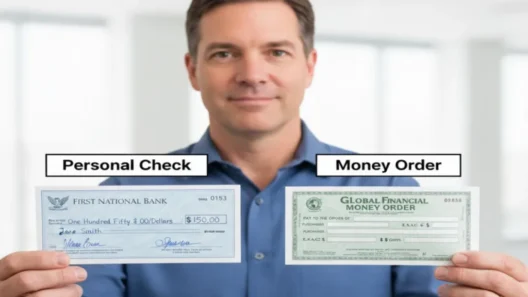
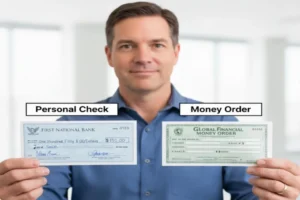
A personal check is the standard check that comes with a checking account. You write in the payee, the amount, the date, and your signature, and the funds are pulled from your account when the recipient deposits or cashes it.
The catch is that a personal check is only a promise. If your balance cannot cover it, the check bounces and you may owe a non-sufficient funds fee. Because of that risk, some sellers and landlords will not accept personal checks for larger amounts.
Personal checks are a good fit for paying bills, sending a gift in a card, or any payment where the other party trusts that the money is there. For rent, a personal check gives you a clean paper trail, though many landlords now prefer guaranteed funds for deposits. See our guide to the security deposit for what landlords can and cannot ask for.
Business checks
A business check works exactly like a personal check but draws on a company account instead of an individual one. Companies use them for vendor payments, reimbursements, and payroll. For everyday consumers, they rarely come up, but it helps to know the term when a company pays you this way.
Certified checks
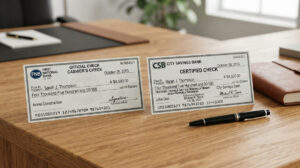
A certified check is a personal check that your bank has verified and stamped. The bank confirms the money is in your account, sets that amount aside so you cannot spend it elsewhere, and marks the check as certified. When the payee cashes it, the funds are guaranteed to be there.
The money still comes from your account, not the bank’s, which is the key difference from a cashier’s check. Certified checks show your personal account details, so they offer less privacy, but they usually cost a little less than a cashier’s check. They are a reasonable middle ground when a recipient wants assurance the funds exist but does not require a full cashier’s check.
Cashier’s checks
A cashier’s check is issued by a bank or credit union and drawn on the bank’s own funds. You pay the bank the amount up front, either from your account or in cash, and the bank writes the check and signs it. Because the bank is the one guaranteeing payment, a cashier’s check is one of the most secure paper payments available and rarely bounces.
There is generally no fixed upper limit as long as you can cover the amount, which makes cashier’s checks the standard for large transactions: a car purchase, a real estate down payment, or closing costs on a house. Fees are modest, often somewhere from nothing at all up to around $20, and some online banks issue them for free.
Money orders
A money order is a prepaid payment you buy with cash or a debit card. You pay the face amount plus a small fee, and you receive a printed order that you fill out to a specific recipient. Because it is prepaid, it cannot bounce.
Domestic money orders are capped at $1,000 each, so they are not built for big purchases, though you can buy several to cover multiple bills. They are cheap, widely available at post offices, grocery stores, and retailers, and do not require a bank account. That last point makes them useful for anyone who is unbanked or who simply wants to keep their banking details private. The U.S. Postal Service alone issued more than 63 million money orders in a single recent year, which shows how common they still are.
Which type should you use?
The right choice comes down to the amount, who you are paying, and how much security each side needs.
- Paying a routine bill or a trusted party: a personal check is fine.
- Landlord wants guaranteed funds for a deposit: a cashier’s check or money order, depending on the amount.
- Buying a car or closing on a home: a cashier’s check, because there is no $1,000 cap and it carries the strongest guarantee.
- Sending a smaller payment by mail, or you have no bank account, a money order.
- Recipient wants proof the funds are real, but you prefer a lower fee: a certified check.
- Paying a court, agency, or government fee: many require a money order or cashier’s check, so check the payee’s rules first.
A note on check fraud
Guaranteed does not mean scam proof. Fake cashier’s checks and money orders are a common fraud, often paired with a request that you deposit the check and wire part of it back. The check can look real, clear briefly, then bounce days later, leaving you responsible for the full amount.
Two habits protect you. First, verify any cashier’s check or money order by calling the issuing bank or company directly, using a number you look up yourself rather than one printed on the item. Second, never send money back to someone who overpaid you with a check. For more on spotting these setups, see our coverage of fake job postings and payment scams.
Frequently asked questions
What is the safest type of check? A cashier’s check is generally the most secure because it is backed by the bank’s own funds and carries strong anti fraud features. A money order is also secure for smaller amounts. Both are safer than a personal check, which can bounce.
Can a cashier’s check or money order bounce? A genuine one will not bounce, since the funds are paid up front. The real risk is a counterfeit that looks legitimate, so verify before you rely on it.
Do I need a bank account to get one? You need an account for a certified check, and usually for a cashier’s check, though some issuers will sell you one for cash plus a fee. You do not need any account for a money order.
How much can each be written for? Personal, certified, and cashier’s checks are limited by your available funds, and cashier’s checks have no fixed upper cap. Domestic money orders are capped at $1,000 each.
Which is cheapest? Money orders, at roughly $1 to $5, are usually the cheapest guaranteed option. Cashier’s and certified checks cost more but handle far larger amounts.
Lead Paragraph publishes general information, not financial or legal advice. Fees, limits, and policies vary by bank and location and can change, so confirm details with the issuer before you make a payment.