Key Moments
Role of a Guarantor
A guarantor covers rent if you default but does not live in the apartment.Guarantor Requirements
Guarantors must meet high income and credit thresholds, typically 80x rent and 700+ credit score.Guarantor vs Cosigner
Unlike cosigners, guarantors are backups with no rights to occupy the unit and are liable after default only.Options Without a Guarantor
If you lack a guarantor, you can use services, larger deposits, or find landlords not requiring one.A guarantor for an apartment is someone who signs your lease as a financial backup and legally agrees to cover your rent if you cannot pay. Unlike a cosigner, a guarantor does not live in the unit and is usually only pursued after you default. Landlords require one when a renter has thin credit, limited income, or no rental history, and they typically expect the guarantor to earn about 80 times the monthly rent with strong credit.
Quick facts
| Question | Short answer |
|---|---|
| What does a guarantor do? | Promises to pay your rent and covered charges if you cannot |
| Do they live in the apartment? | No. A guarantor has no right to occupy the unit |
| Income usually required | About 80x the monthly rent in annual income, sometimes up to 100x |
| Credit usually required | 700 or higher, often 750+ |
| When is one required? | Low or no credit, insufficient income, no rental history, students, self-employed, or international renters |
| Guarantor vs cosigner | A cosigner is a co-tenant liable from day one; a guarantor is a backup pursued only after default |
| Cost of a guarantor service | Roughly 4 to 10% of annual rent, or about 70 to 110% of one month’s rent |
Does your guarantor earn enough?
Most landlords use an income multiple to decide whether a guarantor qualifies. The common benchmark is 80 times the monthly rent in annual income, which is double the 40x standard applied to tenants. Use the calculator to check a specific rent and income before anyone fills out an application.
Does Your Guarantor Earn Enough?
Enter the rent and your landlord’s rule to see the income a guarantor needs — and whether yours qualifies.
Guarantor income needed
$0
These are common industry benchmarks. Individual landlords set their own rules, and some high cost markets use higher multiples. Confirm the exact requirement with the landlord or leasing agent before anyone applies.
For the flip side, whether your own income is high enough to rent without a guarantor at all, run the numbers in our rent affordability calculator.

Guarantor vs cosigner: what is the difference
People use these words interchangeably, but they are not the same, and the difference affects who is liable and when.
| Guarantor | Cosigner | |
|---|---|---|
| Lives in the unit? | No | Often yes, as a co-tenant |
| When are they liable? | Only after the tenant defaults | From day one, equally with the tenant |
| Income usually required | About 80x monthly rent | Meets standard tenant rules, around 40x rent |
| Credit usually required | 700 to 750+ | Standard tenant threshold, often 650+ |
| Right to occupy? | No | Usually yes |
In short, a cosigner is treated as another renter who happens to help you qualify. A guarantor is a pure financial safety net who stays off the property and is only contacted if you stop paying. Because a guarantor absorbs risk without any benefit of living there, landlords hold them to a higher income and credit bar.
When do you need a guarantor?
You may be asked for a guarantor when your application does not clear the landlord’s screening on its own. Common triggers include:
- Income below the threshold. Many landlords want tenants to earn about 40 times the monthly rent per year, or to keep rent at or under 30% of gross income. Fall short and a guarantor fills the gap.
- Limited or no credit history. First-time renters, recent graduates, and international applicants often have too little credit for a landlord to judge risk.
- No rental history. If you have never held a lease, a landlord has nothing to point to.
- Self-employment or irregular income. Freelancers and contractors may have the money but not the steady documentation landlords like to see.
- A competitive market. In high-demand cities, owners raise the bar simply because they can, and a guarantor can move you to the front of the line.
Needing a guarantor is not a judgment on your finances. Plenty of capable renters need one purely because of a market’s income math or a short credit file.
Guarantor requirements
Requirements vary by landlord, but the financial bar is consistently higher than for tenants.
Income. The industry standard is 80 times the monthly rent in annual income, and some landlords go to 90 or 100 times. On a $2,000 per month apartment, an 80x rule means the guarantor needs about $160,000 a year. The logic is that the guarantor has to be able to cover your rent while still carrying their own living costs.
Credit score. Most landlords want a guarantor in the good to excellent range, commonly 700 or higher, and often 750+. A clean history with no recent bankruptcies, defaults, or collections matters as much as the number.
Documentation. A guarantor essentially completes their own rental application. Expect requests for a government-issued ID, recent pay stubs, the last two years of tax returns, bank statements, and consent to a credit and background check.
Location. Some landlords, especially in cities like New York, require the guarantor to live in the same state or region so they can sign the original lease and be reachable. Others accept out-of-state guarantors or a guarantor service instead.
Who can be your guarantor?
The most common choice is a parent, but any financially stable adult who meets the requirements can serve. Close relatives, family friends, and in some cases an employer are all options. Whoever you ask should be at least 21, have reliable income well above the threshold, and hold strong credit. It helps if they own property, since that signals stability to a landlord. You cannot be your own guarantor, and a guarantor cannot rent the unit in your place, since their entire purpose is to be a separate layer of security.
How to ask someone to be your guarantor
Asking someone to guarantee your lease is a real request, since they are taking on financial and legal exposure. A few things make the conversation easier and the answer more likely to be yes:
- Explain exactly what you are asking for and that they would only be pursued if you fail to pay.
- Share your own budget and income so they can see you plan to cover the rent yourself.
- Walk them through the paperwork they will need to provide.
- Be clear about the lease term, so they know how long the commitment runs.
- Give them room to say no. It is a significant favor, and pressure damages relationships.
What it costs to use a guarantor service
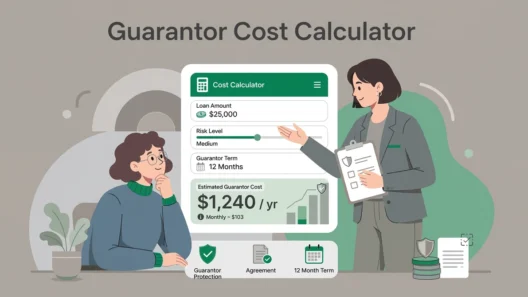
If you do not have someone who can or will guarantee your lease, third-party guarantor companies will do it for a fee. They step in as your guarantor and take on the risk, and in exchange you pay a premium before signing.
Pricing generally lands in one of two forms: roughly 4 to 10% of the annual rent, or somewhere between 70 and 110% of one month’s rent, paid upfront. On a $2,000 per month apartment at a 6% rate, that is about $1,440 for a 12-month lease. Costs depend on your credit, income, and whether you are employed in the US. Not every building accepts third-party guarantors, so confirm acceptance with the landlord before you pay for a service.
The risks your guarantor takes on
Before someone signs for you, they should understand what they are agreeing to. Being a guarantor is not a formality.
- Full financial liability. If you default, the guarantor can be pursued for unpaid rent, damages, and fees, potentially through collections, a lawsuit, or wage garnishment.
- Credit impact. If the guarantor is called on and cannot or does not pay, the missed obligation can hit their credit.
- The deposit does not protect them. Many guaranty agreements do not require the landlord to use your security deposit first. On a costly default, the exposure can run well beyond one month’s rent.
- Renewals can extend the commitment. A continuing guaranty without a sunset clause can bind your guarantor across lease renewals and rent increases, sometimes for years, without them signing anything new. It is worth asking the landlord to limit the guaranty to the initial term.
What to do if you cannot find a guarantor
No one to ask? You still have options:
- Use a guarantor service, keeping the cost above in mind.
- Offer a larger deposit or prepaid rent, where state law and the landlord allow it.
- Show proof of savings to demonstrate you can cover several months of rent.
- Target landlords who do not require a guarantor, which are more common with individual owners than large management companies.
Before you start applying, it helps to have your whole renter profile in order. Our guide on how to rent an apartment walks through the full application, and the first apartment checklist covers what to prepare so you look like a low-risk tenant from the start.
Frequently asked questions
How much does a guarantor need to make for an apartment? Most landlords require a guarantor to earn about 80 times the monthly rent in annual income, and some go up to 100 times. For a $2,000 per month apartment, an 80x rule means roughly $160,000 a year.
Is a guarantor the same as a cosigner? No. A cosigner signs the lease as a co-tenant and is equally responsible from day one, often with the right to live in the unit. A guarantor is a financial backup who does not live there and is usually only pursued after the tenant defaults.
Does being a guarantor affect your credit? Being named as a guarantor does not usually hurt credit on its own. It becomes a problem only if the tenant fails to pay and the guarantor also does not cover the obligation, at which point missed payments or collections can appear.
Can you rent an apartment without a guarantor? Yes. Many renters qualify on their own income and credit. If you do not, alternatives include a guarantor service, a larger deposit, proof of savings, or finding a landlord who does not require one.
What credit score does a guarantor need? Landlords typically want a guarantor in the good to excellent range, commonly 700 or higher and often 750 or above, with no recent bankruptcies, defaults, or collections.
This article is general information about renting and guarantor arrangements, not legal or financial advice. Requirements and costs vary by landlord, city, and state, and change over time. Confirm a landlord’s specific rules and read any guaranty agreement carefully, or consult a qualified professional, before signing.