Key Moments
States Requiring Interest
Only a subset of states legally require landlords to pay interest on security deposits, with diverse rules.Interest Calculation Method
Interest is typically calculated using simple interest based on deposit amount, rate, and holding time.Interest Payment Timing
States differ on whether interest is paid annually or upon move-out.How to Request Owed Interest
Start with a polite written request; if refused, pursue local tenant rights resources or small-claims court.Handing over a security deposit can mean parting with hundreds or thousands of dollars for the length of your lease. What many renters don’t realize is that in a number of states, your landlord is legally required to pay you interest on that money — sometimes credited yearly, sometimes paid back when you move out. The calculator below estimates how much interest you may be owed based on your state, deposit amount, and how long it’s been held.
Pick your state and the rate fills in automatically. If you know your state or city’s current official rate, you can type it in to fine-tune the estimate.
Security Deposit Interest Calculator
Some states require landlords to pay interest on your deposit. Estimate what you may be owed.
Estimated interest owed
$0
Simple-interest estimate for general guidance only — not legal advice. Statutory rates change yearly and some states pay periodically or compound. Confirm your state/city’s current rule.
Which states require interest on security deposits?
Most states do not require landlords to pay interest. But a meaningful group does, and the rules vary widely. States with a clear interest requirement include Massachusetts, Maryland, Minnesota, Connecticut, Illinois, New Jersey, New York, New Hampshire, North Dakota, Pennsylvania, New Mexico, and Washington, D.C. Some big cities layer on their own rules — Chicago’s ordinance, for example, sets its own annual rate that can differ from the Illinois state rule.

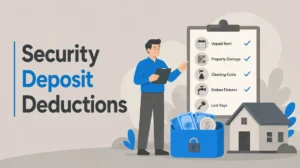
The way interest is set differs just as much as who requires it. A few states name a fixed rate — Massachusetts uses 5% per year, Maryland 1.5%, and Minnesota 1%. Others tie it to a bank or market rate that changes yearly, meaning the landlord must pay whatever a comparable savings account earned. That’s why the calculator lets you override the rate: if your state or city publishes a current figure, plugging it in gives you the most accurate estimate.
How the interest is calculated
The calculator uses simple interest: your deposit multiplied by the annual rate, multiplied by the number of years it’s been held. A $1,500 deposit in Massachusetts held for one year at 5% comes to $75. Keep in mind that some states require interest to be paid or credited every year rather than all at once at move-out, and a handful use compounding, which would push the total slightly higher. Treat the result as a close estimate, not a legal accounting.
When you should get the interest
Timing depends on your state. Some require landlords to pay interest annually — often as a credit toward rent or a separate payment. Others hold it until you move out and return it along with the deposit itself. Either way, the obligation only exists if your state or city has a rule; in the majority of states, a landlord keeps any interest the deposit earns. For the full picture on getting your money back, see our guide on how to get your security deposit back.
Protecting your deposit from the start
Interest is a bonus; getting the whole deposit back is the main event. Document the unit’s condition with dated photos at move-in and move-out, keep a copy of your lease and any move-in inspection, and understand what a landlord can and can’t deduct. If you’re leaving before the lease ends, read our guide on how to break a lease without forfeiting your deposit, and consider whether renters insurance makes sense while you’re in the unit. Renters on flexible terms should also understand how a month-to-month lease affects deposit timing.
How to request the interest you’re owed
If you live in a state that requires interest and your landlord hasn’t paid it, start politely and in writing. Send a short message referencing your state’s security-deposit law, your deposit amount, and the period it’s been held, and ask for the interest to be paid or credited. Keep a copy of everything. Many landlords simply overlook the requirement and correct it once asked. If they refuse in a state where interest is mandatory, you may be entitled to penalties beyond the interest itself — a local tenant rights organization or small-claims court is the usual next step. Bring your lease, proof of the deposit, and your move-in and move-out dates. The same paper trail helps if there’s ever a dispute over deductions when you move out.
Frequently asked questions
Does my landlord have to pay interest on my security deposit?
Only in certain states and cities. Massachusetts, Maryland, Minnesota, Connecticut, Illinois, New Jersey, New York, New Hampshire, North Dakota, Pennsylvania, New Mexico, and Washington, D.C. have requirements, though the rate and timing differ. Most states have no such rule.
How much interest will I get on a security deposit?
It depends on your state’s rate and how long the deposit is held. At a 1% rate, a $1,500 deposit earns about $15 per year; at Massachusetts’ 5%, the same deposit earns about $75 per year.
What if my landlord didn’t pay the interest they owe?
In states that require it, failing to pay interest can carry penalties — sometimes including damages beyond the interest itself. Start by requesting it in writing, and consult a local tenant rights organization or attorney if the landlord refuses.
Is this calculator legal advice?
No. It’s a general estimate to help you understand what you may be owed. Statutory rates and rules change and vary by city, so confirm your specific situation with an official source or a legal professional.
This article is for general information only and is not legal advice. Security deposit laws change frequently and differ by state and city — verify current rules before acting.