
Key Moments
Core Funding Difference
Cashier's checks use the bank's funds, while certified checks freeze your own account funds.Security and Privacy
Cashier's checks offer higher security and privacy without revealing personal account details.Cost and Availability
Certified checks are usually cheaper but less commonly offered than cashier's checks.Fraud Awareness
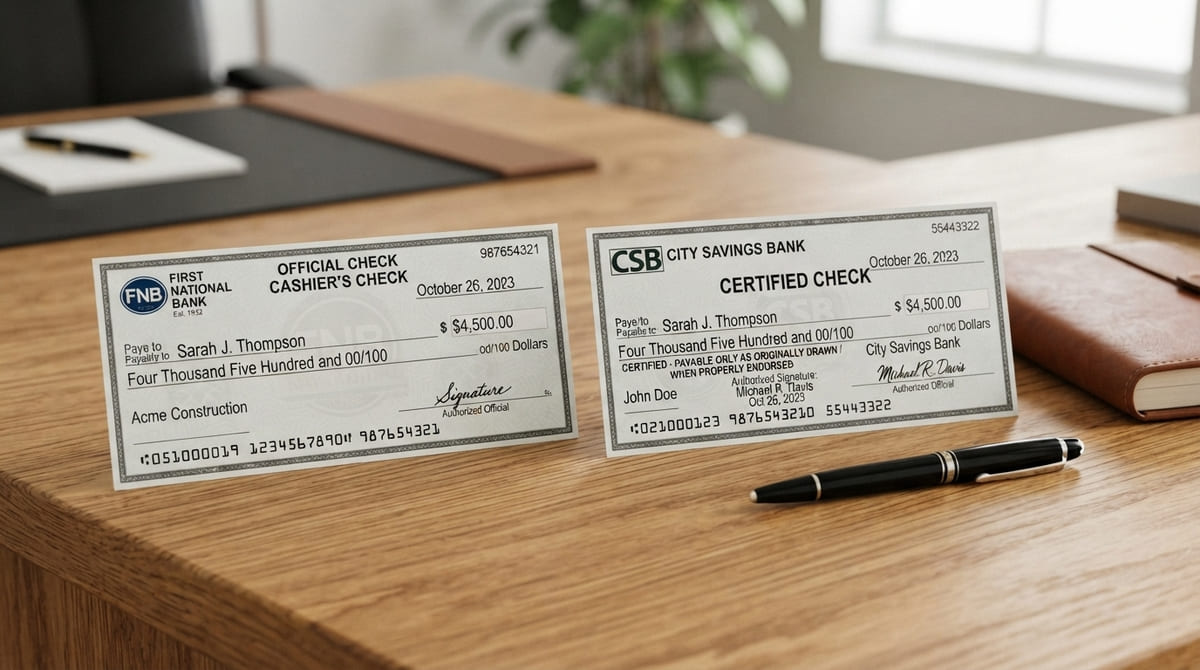
Both check types can be targets of counterfeit scams; verify checks directly with banks.A certified check and a cashier’s check are both official checks that a bank stands behind, which makes them safer than a personal check for big payments. The difference comes down to one thing: whose money backs the check. With a cashier’s check, the bank’s own funds back it. With a certified check, your funds back it, after the bank verifies and freezes them. That single distinction drives everything else.
This page is part of our types of checks series.
Quick facts
| Cashier’s check | Certified check | |
|---|---|---|
| Funds come from | The bank’s own account | Your account, set aside by the bank |
| Who signs it | A bank representative | You |
| Shows your account details | Sometimes | Yes |
| Security | Very high | High |
| Typical cost | About $8 to $15 | Often a bit less |
| Availability | Widely offered | Less common today |
What each one is
A cashier’s check is written by the bank on its own account. You pay the bank the amount up front, the bank moves that money into its own funds, and it issues a check signed by a teller or officer. Because the bank itself is paying, the recipient has strong assurance the check is good. There is generally no upper limit. For how to get one and what it costs, see how to get a cashier’s check and cashier’s check fees.


A certified check is your own personal check that the bank has certified. The bank confirms the money is in your account, sets that exact amount aside so you cannot spend it elsewhere, and stamps or marks the check as certified. You are still the person paying and the one who signs it. The bank is vouching that the funds are there and reserved.
The core difference: who funds it
Think of it as a question of whose account the money sits in at the moment of payment.
- Cashier’s check: the money has already moved into the bank’s account. The bank pays the recipient from its own funds. Your personal account details do not need to appear on the check.
- Certified check: the money stays in your account, frozen for this check. The bank pays from your funds when the check is cashed. Your account details are on the check.
Because a cashier’s check is drawn on the bank rather than on you, it is generally considered the more secure of the two and offers more privacy. A certified check is still secure, since the funds are reserved, but it carries your personal banking information.
Cost and availability
Certified checks usually cost a little less than cashier’s checks, which commonly run about $8 to $15. But there is a practical catch: certified checks have become far less common. Many banks no longer offer them and steer customers to cashier’s checks instead. If you specifically need a certified check, call ahead to confirm your bank still issues them.
For both, you typically need an account at the bank and a government ID, and you request the check in person at a branch.
Which is safer, and which should you use?
For most large payments, a cashier’s check is the safer and more widely accepted choice, and it is the one sellers, landlords, and closing agents usually name. Use it for a car purchase, a home closing, or a security deposit where the other party wants ironclad, bank backed funds.
A certified check makes sense mainly when a recipient specifically asks for one, or when you want the payment to draw from your own account while still giving the recipient assurance the money is reserved. Given how few banks still offer them, though, you will reach for a cashier’s check far more often.
If your payment is under $1,000 and you want a cheaper option, a money order may be enough. See cashier’s check vs. money order to weigh that.
Watch for fraud either way
Both certified and cashier’s checks are targeted by counterfeiters, often in overpayment scams where you are sent a check for too much and asked to refund the difference. The check looks real, clears briefly, then bounces, and you lose what you sent back. Verify any official check by contacting the issuing bank directly with a number you look up yourself, and never return funds against a check you received.
Frequently asked questions
What is the main difference between a certified check and a cashier’s check? Who funds it. A cashier’s check is paid from the bank’s own money. A certified check is paid from your account, with the bank setting the funds aside.
Which is safer? A cashier’s check is generally considered safer and more private, because it is drawn on the bank and does not carry your account details.
Which is cheaper? Certified checks are often slightly cheaper, but many banks no longer offer them, so a cashier’s check at roughly $8 to $15 is the common option.
Can a certified check bounce? It is unlikely, since the bank sets the funds aside when it certifies the check. A genuine one is reliable.
Do I need a bank account to get either? Usually yes for both, though some banks sell cashier’s checks to non customers for cash. Certified checks generally require your own account.
Lead Paragraph publishes general information, not financial or legal advice. Fees, availability, and policies vary by bank and can change, so confirm details with the issuer before you pay.