
Key Moments
Cost Difference by Water Temperature
Heating water causes most energy use, making hot washes up to 8 times more expensive than cold.Energy Consumption of Washing Machines
Motor wattage ranges from 400 to 1,400 watts with cold loads using only about 0.3 to 0.5 kWh.Factors Influencing Washing Machine Costs
Water temperature, machine type, load size, and electricity rates heavily impact cost.Effective Cost-saving Tips
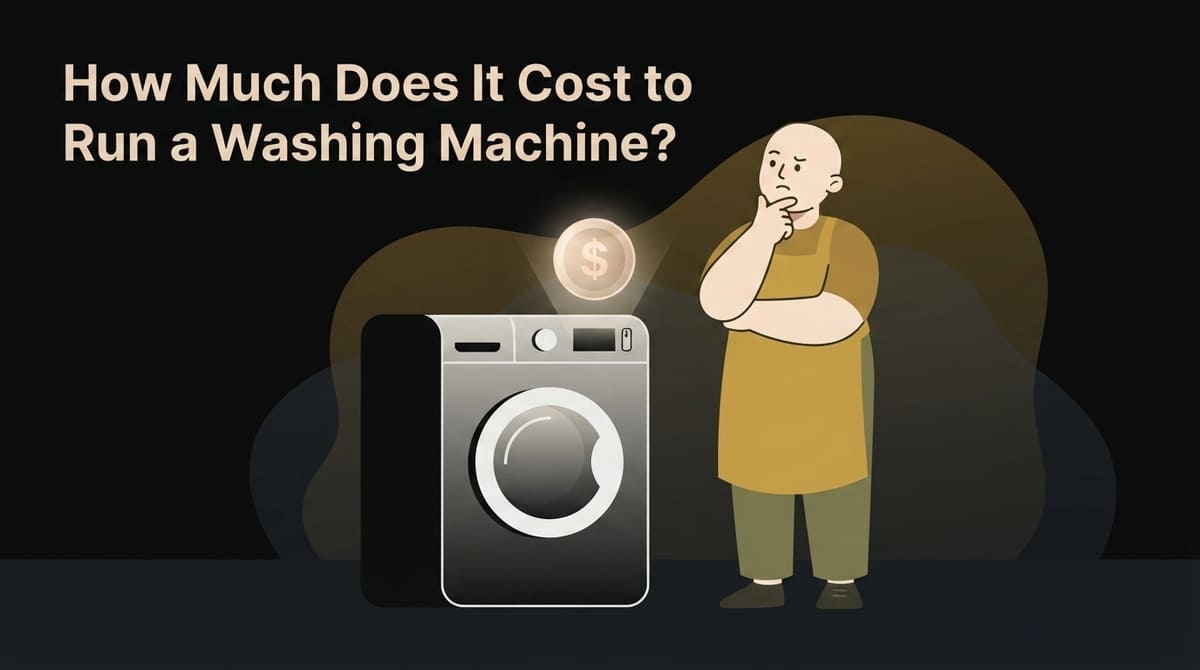
Washing in cold water, full loads, eco cycles, and modern machines reduce electricity expenses.Running a washing machine costs surprisingly little: about 4 to 12 cents of electricity per cold load, which works out to roughly $1 to $8 a month for a typical household doing 5 to 7 loads a week. The machine’s motor is cheap to run. The real cost is the hot water, because heating the water can be around 90 percent of the energy used in a hot wash. Switch your loads to cold and the cost drops sharply.
Quick facts: washing machine running cost
| Detail | Figure |
|---|---|
| Cost per cold load | About 4 to 12 cents |
| Typical monthly cost | $1 to $8 |
| Motor wattage | 400 to 1,400 watts |
| Energy per cold load | About 0.3 to 0.5 kWh |
| Energy per hot load | About 2.5 to 4 kWh |
| 2026 US average electricity rate | About $0.16 to $0.18 per kWh |
| Biggest cost driver | Water temperature, not the motor |
How many watts does a washing machine use?
A washing machine motor draws between 400 and 1,400 watts, with compact and high-efficiency front-loaders at the low end and larger agitator top-loaders higher. A typical cold cycle uses only about 0.3 to 0.5 kilowatt-hours, which is why the electricity for the machine itself is measured in cents, not dollars.
At the 2026 average rate, a cold load costs roughly 4 to 9 cents. Running seven cold loads a week comes to about $1 to $5 a month for most front-loaders, and a little more for older top-loaders.
Why hot water changes everything
Here is the fact that most people miss: in a hot wash, roughly 90 percent of the energy goes to heating the water, not to running the machine. The washer motor barely changes between a cold and a hot cycle. What changes is that your water heater, drawing 4,000 to 5,500 watts, has to raise around 15 gallons of cold tap water to washing temperature.
The result is a big cost gap:
| Cycle | Energy per load | Rough cost per load |
|---|---|---|
| Cold wash | 0.3 to 0.5 kWh | 5 to 9 cents |
| Warm wash | 1 to 2 kWh | 18 to 36 cents |
| Hot wash | 2.5 to 4 kWh | 45 cents to $0.72 |
A household that washes mostly in hot water can spend $10 to $20 a month, while the same household on cold washes spends a fraction of that. Modern detergents are formulated to clean well in cold water, so switching everyday loads to cold can save $50 to $100 a year with no other change.
The formula to work out your own cost
The standard appliance formula applies:
(Watts divided by 1,000) x hours used x your rate per kWh = cost
A 500 watt washer running a 30 minute cold cycle uses 0.25 kWh, which at $0.16 per kWh is about 4 cents. For hot washes, add your water heater’s share, which is where the real cost sits. Our appliance electricity cost calculator handles it, and our guide on what a kilowatt-hour is explains the unit on your bill.
Remember the machine is only half the laundry cost. The dryer uses far more energy per load than the washer, since drying is essentially heating, so it is usually the bigger half of your laundry bill.
What changes the cost most
- Water temperature. By far the biggest factor. Cold versus hot can multiply the per-load cost several times over.
- Machine type and age. Front-loaders use less water and energy than top-loaders, and a 20-year-old machine can use 4 to 8 times the electricity of a new ENERGY STAR model.
- Number of loads. A single person doing 1 to 3 loads a week pays far less than a family doing 7 or more.
- Your electricity rate. The same machine costs nearly four times as much to run in the highest-rate states as in the lowest.
- Load size habits. Small and large loads use similar energy, so full loads are more efficient per item.
How to lower your washing machine cost
- Wash in cold water for everyday loads, the single biggest saving.
- Run full loads rather than frequent small ones, since energy per load barely changes with size.
- Use eco or energy-saving cycles where available.
- Turn your water heater down to 120°F so warm and hot washes cost less.
- Run the machine during off-peak hours if your utility offers time-of-use rates.
- Replace a very old top-loader with an ENERGY STAR model if it is nearing the end of its life.
Because the laundry cost is really a water-heating cost, the washing machine is a good place to look when a bill creeps up. Our guides on why your electric bill is so high and how to lower your electric bill cover the whole home.
FAQ
How much does it cost to run a washing machine per load?
About 4 to 12 cents of electricity for a cold load. A warm load costs roughly 18 to 36 cents and a hot load 45 cents or more, because heating the water is where most of the cost lies.
How many watts does a washing machine use?
Most washing machine motors use 400 to 1,400 watts. High-efficiency front-loaders sit at the low end and larger agitator top-loaders at the high end. Check the EnergyGuide label for your model.
Is it cheaper to wash clothes in cold water?
Much cheaper. In a hot wash about 90 percent of the energy heats the water, so switching to cold can save $50 to $100 a year. Modern detergents clean well in cold water for everyday loads.
How much does a washing machine add to your electric bill?
Usually only $1 to $8 a month for cold and warm washing, rising to $10 to $20 if you wash mostly in hot water. The machine itself is cheap, the water heating is not.
Does the dryer cost more than the washing machine?
Yes, considerably. A dryer uses around 3 kWh per load against roughly 0.5 kWh for a cold wash, because drying is mostly heating. The dryer is usually the bigger half of your laundry bill.
Disclaimer: This article is general information, not financial advice. Electricity rates, machine types and washing habits vary widely, so figures are 2026 US averages for guidance only. Check your machine’s label and your electricity bill’s per-kWh rate for an accurate estimate.