
Key Moments
Monthly and Annual Costs
Most freezers cost $2.40 to $7.50 monthly or $30 to $75 yearly depending on size and type.Power Usage and Compressor Cycling
Freezers have a nameplate wattage of 100-400 watts but cycle compressors reduce effective draw to about 40 watts.Chest vs Upright Efficiency
Chest freezers use 30-40% less electricity than upright models due to their top-opening design.Factors Affecting Running Cost
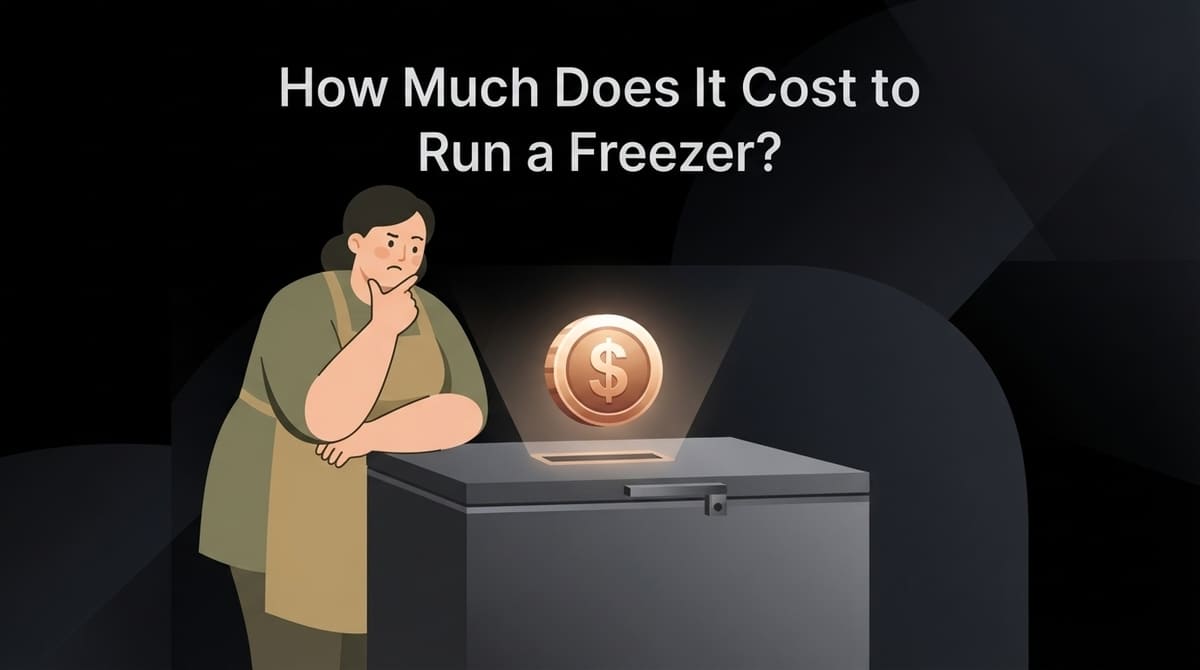
Type, age, size, placement, electricity rate, and fullness significantly impact freezer energy consumption.A standalone freezer costs most households between $2.40 and $7.50 a month to run, or roughly $30 to $75 a year, depending on its size, type, age and your electricity rate. That makes it one of the cheapest 24/7 appliances in the home, cheaper than most streaming subscriptions. An efficient modern chest freezer costs closer to the low end at about $3 to $4 a month, while a large or older upright sits nearer the top.
Quick facts: freezer running cost
| Detail | Figure |
|---|---|
| Typical monthly cost | $2.40 to $7.50 |
| Typical annual cost | $30 to $75 |
| Nameplate wattage | 100 to 400 watts |
| Effective average draw | About 40 watts (compressor cycles) |
| Annual energy use | About 200 to 400 kWh |
| 2026 US average electricity rate | About $0.16 to $0.18 per kWh |
| Cheapest type | Chest freezer, 30 to 40 percent less than upright |
How many watts does a freezer use?
A freezer’s nameplate wattage is 100 to 400 watts, but that figure is misleading because the compressor does not run all the time. Once the contents are frozen, the compressor cycles on only to pull the temperature back down, then shuts off, running roughly 25 to 35 percent of the day. That brings the effective continuous draw down to around 40 watts for a typical modern unit.
Because of this cycling, the honest number to use is not the nameplate watts but the annual kWh figure on the yellow EnergyGuide label. A modern chest freezer uses about 200 to 400 kWh a year, which at the 2026 average rate is roughly $30 to $75.

Chest versus upright: the cost difference
Freezer type is the biggest controllable factor. A chest freezer uses about 30 to 40 percent less electricity than an upright of the same capacity, for a simple physics reason: cold air sinks, so when you open a top-loading chest, little cold air escapes, while opening an upright dumps the cold air out the front like a fridge.
| Freezer | Typical annual kWh | Typical annual cost |
|---|---|---|
| Chest, 5 cu ft | About 200 kWh | About $35 |
| Chest, 15 cu ft (ENERGY STAR) | About 215 to 220 kWh | About $35 to $40 |
| Chest, 22 cu ft | About 315 kWh | About $55 |
| Upright, 16 cu ft | About 395 to 400 kWh | About $60 to $72 |
The trade-off is convenience: a chest is harder to organise and reach into than an upright’s shelves. That is the whole decision in two numbers, lower running cost versus easier access.
The formula to work out your own cost
Every appliance uses the same formula, but for a freezer the annual kWh route is more accurate than watts because of the cycling:
Annual kWh (from the EnergyGuide label) x your rate per kWh = yearly cost
So a freezer rated at 350 kWh a year at $0.16 per kWh costs 350 x 0.16, which is about $56 a year, or roughly $4.67 a month. Our appliance electricity cost calculator does the maths, and our guide on what a kilowatt-hour is explains the unit your bill uses.
What changes the cost most
- Type. Chest beats upright by 30 to 40 percent for the same capacity.
- Age. A freezer over 10 to 15 years old can use roughly twice the electricity of a new ENERGY STAR model for the same job.
- Size. Bigger units cost more, and an oversized freezer wastes energy cooling empty space. Around 1.5 cubic feet per person is a common guide.
- Placement. A hot garage in summer can push consumption 20 to 40 percent above the label figure, since the compressor works harder against the heat. A cool basement is cheaper.
- Your electricity rate. The same 350 kWh freezer costs about $56 a year at the average rate but around $105 in the highest-rate states.
- How full it is. Frozen food acts as thermal mass, so a fuller freezer holds its cold better and cycles less.
How to lower your freezer cost
- Choose a chest freezer over an upright if running cost matters more than convenience.
- Right-size it to what you actually store rather than buying oversized.
- Keep it in a cool spot like a basement rather than a hot garage.
- Keep it reasonably full so the frozen contents help hold the temperature.
- Check the door seal is airtight and set the temperature to 0°F, not colder.
- Defrost manual-defrost models before frost builds past a quarter inch.
- Replace a pre-2010 unit with an ENERGY STAR model if it is nearing the end of its life.
A standalone freezer adds only a small amount to a bill, but an old one in a hot garage can quietly cost double what it should. If your bill has crept up, our guides on why your electric bill is so high and how to lower your electric bill look at the whole home.
FAQ
How much does it cost to run a freezer per month?
Most standalone freezers cost $2.40 to $7.50 a month at average rates. An efficient chest freezer is nearer $3 to $4, while a large or older upright is at the higher end.
How many watts does a freezer use?
The nameplate is usually 100 to 400 watts, but because the compressor cycles on and off, the effective average draw is closer to 40 watts. Use the annual kWh figure on the EnergyGuide label for an accurate cost.
Is a chest or upright freezer cheaper to run?
A chest freezer is cheaper, using about 30 to 40 percent less electricity than an upright of the same size, because its top-opening design lets less cold air escape. The upright wins on convenience.
Does a freezer use a lot of electricity?
No. A freezer uses about 200 to 400 kWh a year, less than a refrigerator and far less than heating, cooling or a water heater. It is one of the more affordable always-on appliances.
Does a freezer cost more to run in the garage?
It can. In a hot garage that hits 100°F in summer, the compressor works harder to hold 0°F inside, so real-world energy use can run 20 to 40 percent above the label figure. A cool basement is cheaper.
Disclaimer: This article is general information, not financial advice. Electricity rates, freezer types and placement vary widely, so figures are 2026 US averages for guidance only. Check your freezer’s EnergyGuide label and your electricity bill’s per-kWh rate for an accurate estimate.