
Key Moments
Typical Running Cost
A heat pump usually costs between $50 and $125 per month depending on system size and season.Electricity Usage and Efficiency
Heat pumps use 1,700 to 3,500 watts depending on size and deliver 2-4 units of heat per unit of electricity.Cost Variation by Season and Size
Winter heating costs are higher than cooling, with larger systems costing more.Ways to Reduce Costs
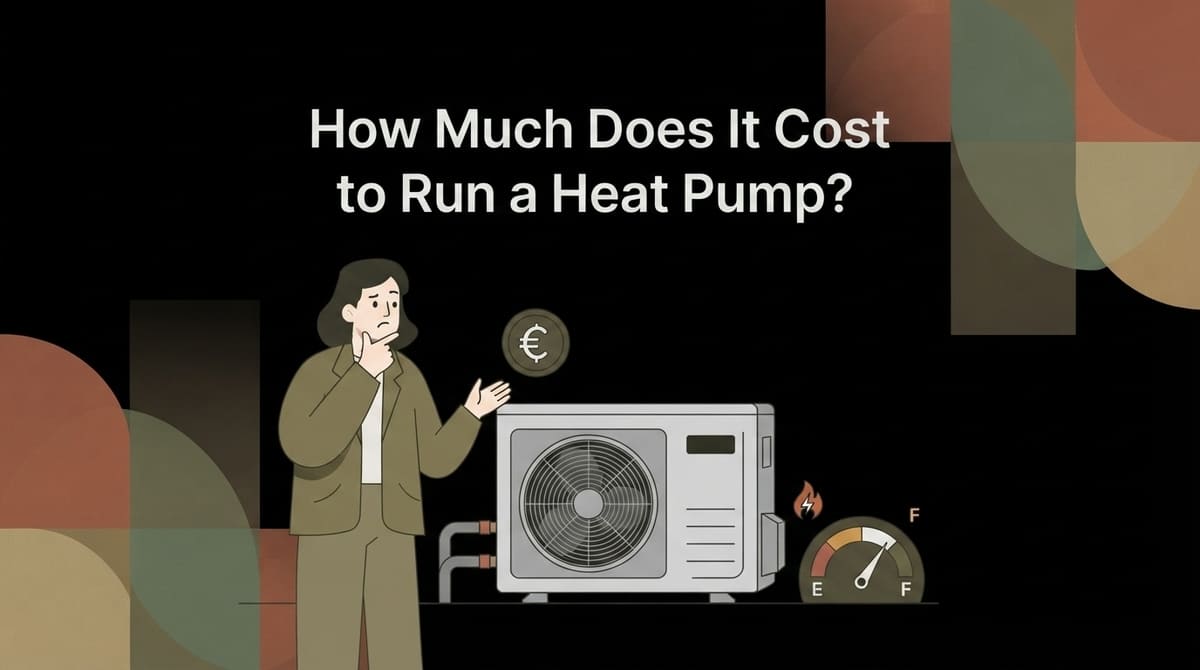
Maintaining steady temperature, sealing leaks, proper sizing, and using smart thermostats lower running expenses.A heat pump costs most homes between $50 and $125 a month to run, depending on the system size, the season and your electricity rate. A typical 3-ton air-source heat pump runs about $89 a month for winter heating and around $60 a month for summer cooling at the 2026 US average rate of roughly $0.18 per kWh, dropping to under $30 in mild shoulder-season months. Because one heat pump handles both heating and cooling, that single figure replaces both a furnace and an air conditioner on your bill.
Quick facts: heat pump running cost
| Detail | Figure |
|---|---|
| Typical monthly cost | $50 to $125 |
| 3-ton heating (winter) | About $89 a month |
| 3-ton cooling (summer) | About $60 a month |
| Shoulder season | Under $30 a month |
| Wattage | About 1,700 to 3,500 watts by size |
| 2026 US average electricity rate | About $0.16 to $0.18 per kWh |
| Efficiency vs electric resistance heat | 2 to 3 times cheaper |
How much electricity does a heat pump use?
A heat pump’s draw depends on its size, measured in tons. A small 2-ton unit pulls about 1,700 to 3,000 watts, a typical 3-ton unit about 2,500 watts, and a large 4-ton unit around 3,500 watts. In heating mode, running roughly 12 hours a day, a 3-ton unit uses close to 495 kWh a month.
The reason a heat pump is efficient is that it does not create heat, it moves it. For every unit of electricity it draws, it can deliver two to four units of heat, which is why it costs far less to run than any form of electric resistance heating for the same warmth.
Heat pump cost by size and season
Heating always costs more than cooling because winter runs the system harder and longer. These are typical monthly figures at the average US rate.
| System size | Winter heating | Summer cooling | Shoulder season |
|---|---|---|---|
| 2-ton (small home) | About $64 | About $43 | About $20 |
| 3-ton (typical) | About $89 | About $60 | About $30 |
| 4-ton (large home) | About $125 | About $83 | About $40 |
Your own figure moves most with your electricity rate. The same 3-ton unit running 12 hours a day in winter costs about $62 a month in a low-rate state, around $89 at the national average, and over $150 in the highest-rate states.
The formula to work out your own cost
Every appliance uses the same formula:
(Watts divided by 1,000) x hours used x your rate per kWh = cost
So a 2,500 watt heat pump running 12 hours at $0.18 per kWh costs (2500 / 1000) x 12 x 0.18, which is about $5.40 a day or roughly $162 a month at peak winter usage. In practice the system cycles rather than running flat out, so real bills are usually lower. Our appliance electricity cost calculator handles the maths, and our guide on what a kilowatt-hour is explains the unit on your bill.
Why a heat pump beats electric heat
This is the number that matters most. A heat pump runs 2 to 3 times cheaper than electric resistance heating, such as baseboard heaters or electric furnaces, for the same comfort. A unit with a good HSPF rating can deliver about three times the heat of a baseboard heater for the same electricity. The Department of Energy estimates a typical heat pump saves $300 or more a year against the heating it replaces, and often over $1,000 when replacing an inefficient system.
Efficiency does drop in deep cold, below about 10°F, where the system works harder and may lean on backup heat. In very cold climates a cold-climate-rated model or a backup heat source helps keep costs down.
What changes the cost most
- Season. Winter heating is the expensive part. Cooling costs less, and shoulder months least of all.
- Your electricity rate. The biggest external factor, moving the same system’s cost by more than three times between the cheapest and most expensive states.
- System size and home size. Bigger homes need bigger units that draw more power.
- Efficiency rating. Higher SEER (cooling) and HSPF (heating) ratings mean less electricity for the same comfort.
- Insulation and air sealing. A leaky, poorly insulated home forces the system to run longer. Sealing gaps and insulating cuts runtime directly.
- Climate and backup heat. Frequent very cold nights that trigger backup resistance heat raise the bill sharply.
How to lower your heat pump cost
- Set a steady temperature rather than large swings, since the system uses less energy holding a temperature than recovering from a big setback.
- Use a programmable or smart thermostat to ease back when you are asleep or away.
- Seal air leaks and improve insulation so heat does not escape.
- Keep filters clean and have the system serviced so it runs efficiently.
- Make sure the system is correctly sized, since an oversized or undersized unit cycles inefficiently.
- Check for federal tax credits and utility rebates, which can offset an efficient upgrade.
Because heating and cooling are the largest part of most electricity bills, the heat pump is usually the first place to look when a bill spikes. Our guides on why your electric bill is so high and how to lower your electric bill cover the whole home.
FAQ
How much does it cost to run a heat pump per month?
Most homes pay $50 to $125 a month, depending on system size, season and rate. A typical 3-ton unit runs about $89 in winter, $60 in summer, and under $30 in mild months.
Do heat pumps use a lot of electricity?
They use a meaningful amount because heating and cooling are big loads, but they are far more efficient than electric resistance heat, delivering two to four units of heat per unit of electricity. That makes them one of the cheapest ways to heat with electricity.
Is a heat pump cheaper than electric heating?
Yes, by a wide margin. A heat pump runs 2 to 3 times cheaper than baseboard or electric furnace heating for the same warmth, which is why it often saves $300 or more a year.
Why is my heat pump so expensive to run in winter?
Deep cold makes a heat pump work harder and can trigger backup resistance heat, which uses far more power. A high electricity rate, poor insulation, or an undersized system also push the winter bill up.
How much does a heat pump add to your electric bill?
Often around $50 a month for a typical 3-ton system in a moderate climate, though it replaces your separate heating and cooling costs rather than adding to them. Over a year it usually lowers total heating costs compared with what it replaced.
Disclaimer: This article is general information, not financial advice. Electricity rates, system sizes, climates and homes vary widely, so figures are 2026 US averages for guidance only. Check your system’s specifications and your electricity bill’s per-kWh rate for an accurate estimate.