
Key Moments
Variable-Speed Pumps Save Most
Variable-speed pumps can reduce running costs by 50 to 90 percent compared to single-speed models.Pool Pump Energy Usage
Pool pumps consume significant electricity because they run many hours daily during the pool season.Key Cost Factors
Pump type, electricity rate, runtime, and pump/pool size majorly affect running costs.Cost Reduction Tips
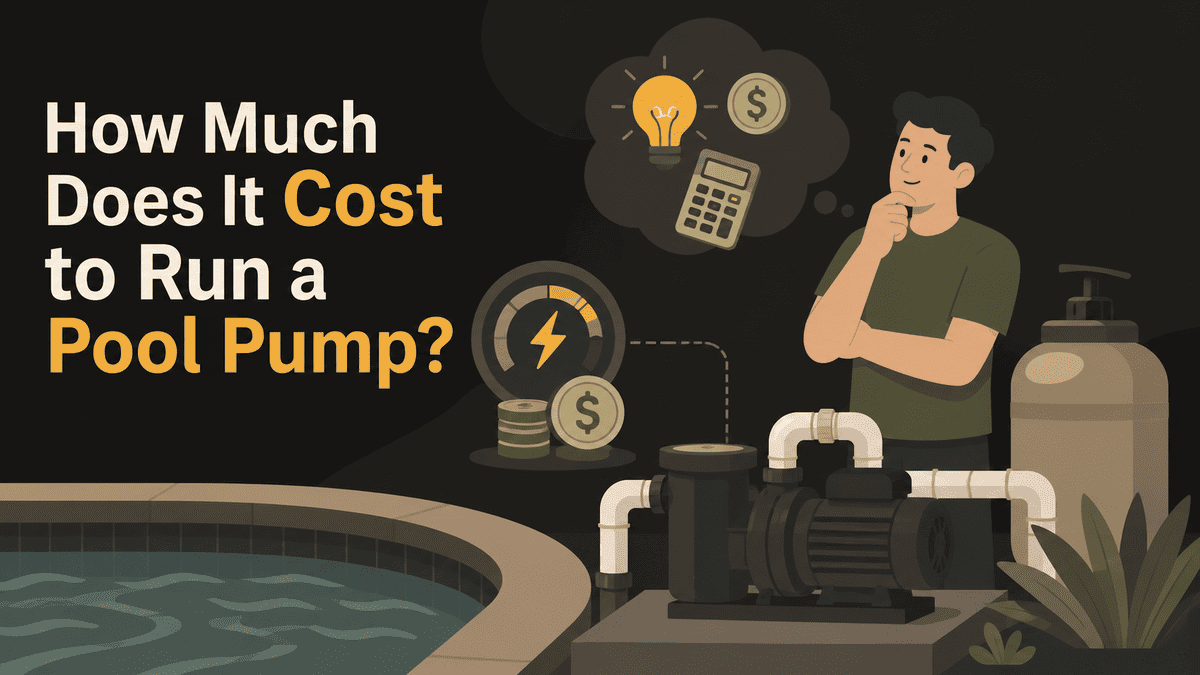
Upgrading pumps, reducing runtime, running off-peak, and clean maintenance lower operating costs.Running a pool pump costs most owners between $30 and $150 a month, depending on the pump type, its horsepower, how many hours a day it runs and your electricity rate. The pump type matters more than almost anything else: a single-speed pump typically costs $50 to $150 a month, while a variable-speed pump doing the same job often costs just $10 to $50. At the 2026 US average rate of about $0.16 to $0.18 per kWh, a standard 2,000 watt single-speed pump running 8 hours a day lands near $80 to $90 a month.
Quick facts: pool pump running cost
| Detail | Figure |
|---|---|
| Typical monthly cost | $30 to $150 |
| Single-speed pump | $50 to $150 a month |
| Variable-speed pump | $10 to $50 a month |
| Single-speed wattage | 1,500 to 2,500 watts |
| Variable-speed wattage | 300 to 700 watts on low |
| 2026 US average electricity rate | About $0.16 to $0.18 per kWh |
| Share of a pool’s energy use | Roughly 50 to 70 percent |
How much electricity does a pool pump use?
A pool pump is one of the biggest energy users in many homes, often the second largest after heating and cooling. The reason is not that it draws huge power, but that it runs for many hours every day through the whole pool season.
A single-speed pump draws 1,500 to 2,500 watts and runs at full power the entire time, with no low gear. Running one 8 hours a day means about 16 kWh a day, or roughly 480 kWh a month. At the national average that is close to $80 to $90 a month for the pump alone.

Why variable-speed pumps cost so much less
This is the single most important number on the page. A variable-speed pump can cut pool pump running costs by 50 to 90 percent, and the reason is physics, not marketing.
Pump energy follows the affinity law: halving the pump’s speed cuts its energy use by roughly eight times. A variable-speed pump run slowly for longer moves the same water while drawing only 300 to 700 watts instead of 2,000. That is why a variable-speed pump often costs $10 to $50 a month against $50 to $150 for a single-speed model doing the same filtration. The upfront cost is higher, but the annual saving is frequently $800 or more, so the pump commonly pays for itself in 1 to 2 years.
| Pump type | Typical monthly cost |
|---|---|
| Single-speed | $50 to $150 |
| Dual-speed (mostly on low) | $30 to $50 |
| Variable-speed | $10 to $50 |
The formula to work out your own cost
Every appliance uses the same formula:
(Watts divided by 1,000) x hours used x your rate per kWh = cost
Find your pump’s wattage by reading the volts and amps off the motor label and multiplying them, then divide by 1,000 for kilowatts. So a 2,000 watt pump running 8 hours at $0.16 per kWh costs (2000 / 1000) x 8 x 0.16, which is about $2.56 a day or roughly $77 a month. Our appliance electricity cost calculator does the maths, and our guide on what a kilowatt-hour is explains the unit your bill charges by.
What changes the cost most
- Pump type. As above, variable-speed versus single-speed is the biggest lever, worth up to a 90 percent difference.
- Your electricity rate. The same 2,000 watt pump costs about $43 a month in a low-rate state and around $165 in Hawaii. Rates range from roughly $0.09 to over $0.40 per kWh.
- Runtime. The rule of thumb is to turn the water over once a day, which is usually 6 to 8 hours, not the 10 to 12 many timers default to. Cutting from 10 hours to 7 saves about 30 percent.
- Pump and pool size. Bigger pumps and larger pools draw more and run longer.
- Season. Summer runtimes of 10 to 12 hours cost far more than the 4 to 6 hours many pools need in winter.
How to lower your pool pump cost
- Upgrade to a variable-speed pump if you still run a single-speed model, the biggest saving available, and check for utility rebates of $100 to $350.
- Cut runtime to the minimum that keeps the water clear, often 6 to 8 hours rather than 10 to 12.
- Run the pump overnight if your utility offers cheaper off-peak rates.
- Keep the filter clean and the plumbing free of restrictions so the pump works less.
- Use a pool cover to reduce debris and the filtration time needed.
If your summer electricity bill jumps, the pool pump is a prime suspect. Our guides on why your electric bill is so high and how to lower your electric bill put it in the context of your whole home.
FAQ
How much does it cost to run a pool pump per day?
Roughly $2 to $6.50 a day for a single-speed pump at average rates, depending on wattage and hours. A variable-speed pump on low can cost under $1 a day for the same filtration.
Do pool pumps use a lot of electricity?
Yes, more than most home appliances, mainly because they run so many hours a day. A single-speed pump can account for 15 to 25 percent of summer electricity use and is often the second-biggest draw after air conditioning.
Is a variable-speed pool pump worth it?
Usually yes. It can cut running costs by 50 to 90 percent, often saving $800 or more a year, and typically pays back its higher purchase price within 1 to 2 years, faster with a utility rebate.
How many hours a day should I run my pool pump?
Enough to turn the water over once, which for most residential pools is about 6 to 8 hours. Many timers are set longer than needed, so trimming the runtime is an easy saving.
Why is my pool pump so expensive to run?
The usual causes are a single-speed pump, a runtime longer than necessary, a high local electricity rate, or an oversized pump. Switching to variable-speed and cutting runtime address the two biggest ones.
Disclaimer: This article is general information, not financial advice. Electricity rates, pump types and usage vary widely, so figures are 2026 US averages for guidance only. Check your pump’s label and your electricity bill’s per-kWh rate for an accurate estimate.