
Key Moments
Ceiling fan running cost
Typical ceiling fan costs range from $1 to $8 a month, making it very economical.Wattage differences between fan types
DC-motor fans use significantly fewer watts than traditional AC fans for the same airflow.Cost comparison with air conditioning
Fans are roughly 10 to 20 times cheaper to run than air conditioners and enable thermostat savings.Ways to reduce fan electricity usage
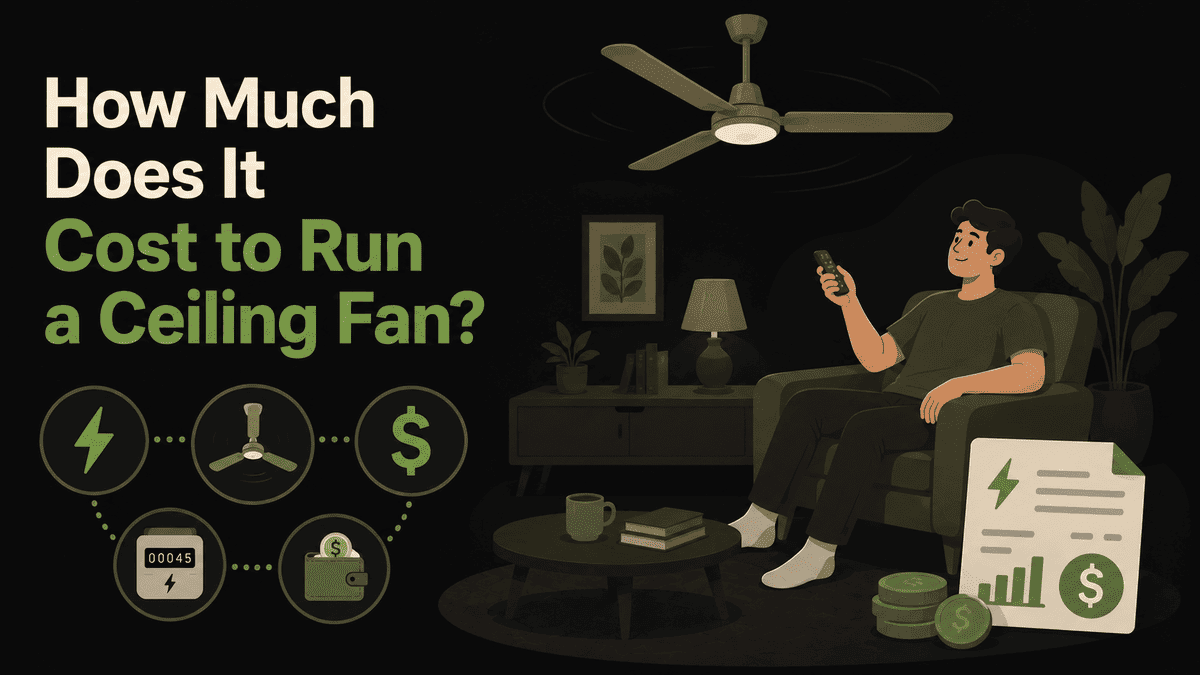
Use DC fans, turn off in empty rooms, run lower speeds, and switch off the light kit to save electricity.A ceiling fan costs only about $1 to $8 a month to run, or roughly one to two cents an hour, making it one of the cheapest appliances in your home. A standard 52-inch fan running 8 hours a day at the 2026 US average rate of about $0.16 per kWh costs around $3 to $8 a month. Even left on 24 hours a day, most fans stay under about $12 a month, and an efficient DC-motor model can cost as little as a cup of coffee a week.
Quick facts: ceiling fan running cost
| Detail | Figure |
|---|---|
| Typical cost per hour | $0.002 to $0.016 (under 2 cents) |
| Typical cost per month | $1 to $8 |
| Wattage range | 15 to 100 watts |
| Average 52-inch fan | About 60 to 75 watts (AC motor) |
| DC-motor fan | About 20 to 45 watts |
| 2026 US average electricity rate | About $0.16 to $0.18 per kWh |
How many watts does a ceiling fan use?
A ceiling fan’s wattage depends mostly on its motor type and size, and the range is small. A standard 52-inch fan with a traditional AC motor draws about 60 to 75 watts on high. A newer DC-motor fan of the same size delivers the same airflow on just 20 to 45 watts. Fan size matters less than motor type: a large 62-inch DC fan can use less power than a small 52-inch AC fan.
| Fan type and size | Typical watts on high |
|---|---|
| Small 36-inch (AC) | 15 to 55 W |
| Standard 52-inch (AC) | 60 to 85 W |
| Large 56-inch+ (AC) | 45 to 100 W |
| DC-motor (any size) | 20 to 45 W |
One easy-to-miss cost: the light kit. An integrated fan light can draw as much power as the fan motor itself, so running the fan with the light on can roughly double the cost. If you want airflow but not light, switch the light off.

Ceiling fan cost per hour, month and year
The numbers are small at every timescale. At $0.16 per kWh:
| Usage | 60 W fan | 30 W DC fan |
|---|---|---|
| Per hour | About $0.01 | About $0.005 |
| Per day (8 hours) | About $0.08 | About $0.04 |
| Per month (8 hrs/day) | About $2.30 | About $1.15 |
| Per month (24/7) | About $7 | About $3.50 |
| Per year (8 hrs/day) | About $28 | About $14 |
Even running a standard fan around the clock for a full month costs less than most people expect, which is why fans are one of the most affordable ways to stay comfortable.
The formula to work out your own cost
Ceiling fans use the same formula as every other appliance:
(Watts divided by 1,000) x hours used x your rate per kWh = cost
A 60 watt fan running 8 hours at $0.16 per kWh costs (60 / 1000) x 8 x 0.16, which is about $0.08 a day or roughly $2.30 a month. Find the wattage on the fan’s label or manual, and your rate on your electricity bill. To skip the arithmetic, use our appliance electricity cost calculator, and see our guide on what a kilowatt-hour is if the unit on your bill is unfamiliar.
Ceiling fan versus air conditioning
A ceiling fan is roughly 10 to 20 times cheaper to run than air conditioning, but the two do different jobs. A fan cools people through a wind-chill effect on the skin, while an AC actually lowers the air temperature. That difference is where the real saving lies: running a fan lets you raise the thermostat about 4°F with no loss of comfort, and every degree higher cuts cooling costs by 3 to 5 percent. Used together, a fan plus a higher AC setpoint can save around $200 across a long cooling season.
Because a fan only cools people, not empty rooms, the cheapest habit is simply switching it off when you leave. For the cooling side of that equation, see our guide on how much it costs to run a window AC.
How to lower your ceiling fan cost
- Choose a DC-motor fan, which uses 30 to 70 percent less electricity than an AC motor for the same airflow and pays back its small price premium in about 18 months.
- Turn the fan off in empty rooms, since it cools people rather than air.
- Run it on a lower speed, which uses noticeably less power.
- Switch the light kit off when you only need airflow.
- Use the lowest comfortable speed and a timer overnight.
Fans are already so cheap that the biggest savings come from using them smartly with your air conditioning rather than worrying about the fan’s own tiny cost. If your overall bill is high, our guides on why your electric bill is so high and how to lower your electric bill look at the whole home.
FAQ
How much does it cost to run a ceiling fan 24 hours a day?
Running non-stop, a standard 60 watt fan costs about $7 a month at average rates, and an efficient DC fan about $3.50. Even in a high-rate state, a fan running all night costs only a few cents.
How many watts does a ceiling fan use?
Most ceiling fans use 15 to 100 watts. A standard 52-inch AC-motor fan averages about 60 to 75 watts, while a DC-motor fan of the same size uses only 20 to 45 watts.
Is it expensive to leave a ceiling fan on all the time?
No. Even running 24/7 a typical fan costs only around $3 to $12 a month depending on motor type and your rate. It is one of the least expensive appliances to run continuously.
Do ceiling fans use more electricity than the light?
Often the light kit uses as much power as the fan motor or more. Running the fan with an old incandescent light kit can double the cost, so switching to LED bulbs or turning the light off saves.
Does fan speed change how much electricity it uses?
Yes. A lower speed draws less power, and low can use 50 to 60 percent less than high. Using the lowest comfortable speed is a simple way to trim an already small cost.
Disclaimer: This article is general information, not financial advice. Electricity rates, fan wattages and usage vary, so figures are 2026 US averages for guidance only. Check your fan’s wattage label and your electricity bill’s per-kWh rate for an accurate estimate.