
Key Moments
Hourly and Monthly Cost Range
Window AC units typically cost between $0.08 to $0.24 per hour and $15 to $75 per month depending on size and usage.Formula to Calculate Electricity Cost
Cost can be calculated with (Watts/1000) x hours used x rate per kWh for personalized estimates.Factors Affecting Running Costs
Electricity rate, usage hours, unit size relative to room, efficiency rating, and insulation greatly impact costs.Strategies to Reduce Costs
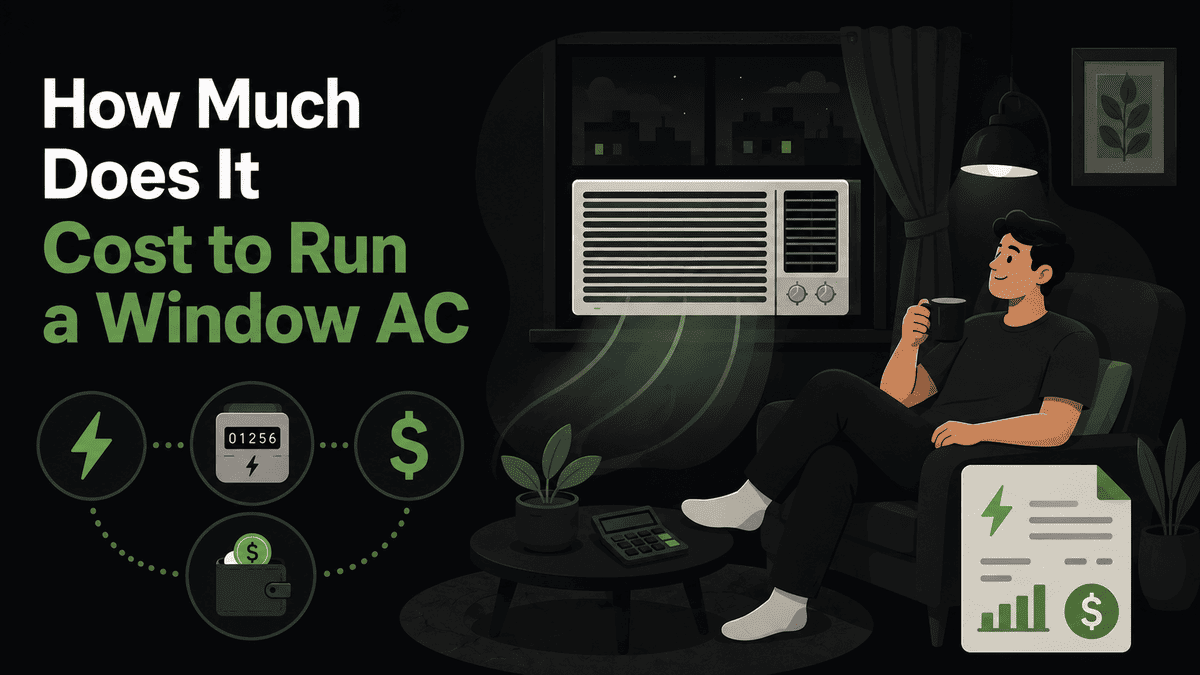
Right-sizing, using timers, maintaining clean units, moderate temperature settings, and sealing gaps help lower costs.Running a window air conditioner costs most households between $15 and $75 a month, or roughly $0.08 to $0.24 an hour, depending on the unit’s size, how many hours you run it and your local electricity rate. A typical 8,000 BTU unit running 8 hours a day at the 2026 US average rate of about $0.16 per kWh lands near $30 to $40 a month. Because the compressor cycles off once the room is cool, real bills usually run 30 to 50 percent below the worst-case, always-on estimate.
Quick facts: window AC running cost
| Detail | Figure |
|---|---|
| Typical cost per hour | $0.08 to $0.24 |
| Typical cost per month | $15 to $75 |
| Wattage range | 450 to 1,500 watts, by BTU size |
| 2026 US average electricity rate | About $0.16 to $0.18 per kWh |
| Cheapest way to cut it | Right-size the unit and let it cycle |
| Standby (phantom) draw | 1 to 5 watts, under $1 a year |
How much does a window AC cost per hour?
The cost per hour depends on the unit’s wattage, which is set by its cooling capacity in BTU. Bigger units cool faster but draw more power.
| Unit size | Typical running watts | Cost per hour at $0.16/kWh |
|---|---|---|
| 5,000 BTU (small bedroom) | About 450 W | About $0.07 |
| 8,000 BTU (medium room) | About 715 W | About $0.11 |
| 10,000 BTU (large room) | About 1,000 W | About $0.16 |
| 12,000 BTU (living room) | About 1,200 W | About $0.19 |
| 15,000 BTU (great room) | About 1,450 W | About $0.23 |
These figures assume the compressor runs the full hour. In practice a properly sized unit reaches temperature and cycles off, so your real hourly cost is usually lower.
How much does a window AC cost per month?
Monthly cost is just the hourly figure multiplied by how long you run it. Running 8 hours a day for 30 days at $0.16 per kWh:
| Unit size | Continuous-run estimate | Realistic cost with cycling |
|---|---|---|
| 5,000 BTU | About $17 a month | About $10 to $13 |
| 8,000 BTU | About $27 a month | About $18 to $25 |
| 10,000 BTU | About $38 a month | About $25 to $32 |
| 12,000 BTU | About $46 a month | About $30 to $38 |
| 15,000 BTU | About $56 a month | About $35 to $45 |
Run the unit around the clock during a heat wave and costs climb to roughly $50 to $170 a month for larger units, though cycling still trims the top end.
The formula to work out your own cost
You do not need a calculator to get close. The formula every energy guide uses is the same one:
(Watts divided by 1,000) x hours used x your rate per kWh = cost
So a 1,000 watt unit running 6 hours at $0.16 per kWh costs (1000 / 1000) x 6 x 0.16, which is about $0.96 a day, or roughly $29 a month. Find your unit’s wattage on its label or in the manual, and find your rate on your electricity bill. If you want to skip the arithmetic, our appliance electricity cost calculator does it for you, and our guide on what a kilowatt-hour is explains the unit your bill charges you by.
What changes the cost most
- Your electricity rate. This is the single biggest variable. The same 8,000 BTU unit that costs about $19 a month in a $0.10 per kWh state can cost close to $58 a month at $0.30 per kWh. Rates range from about $0.11 in Louisiana to over $0.40 in Hawaii.
- Hours of use. Running 4 hours a day rather than 12 cuts the bill by two thirds. A timer or the unit’s sleep mode is the easiest saving.
- Unit size versus room size. An oversized unit short-cycles and an undersized one runs non-stop. Matching BTU to the room keeps runtime and cost down.
- Efficiency rating. A higher CEER or ENERGY STAR unit uses noticeably less power for the same cooling.
- Insulation and heat. Sealing leaks around windows and doors, and closing blinds against the sun, cuts how long the unit has to run.
How to lower your window AC cost
- Right-size the unit to the room so it cools efficiently and cycles rather than running flat out.
- Use a timer or the built-in sleep function so it is not cooling an empty room.
- Set a comfortable but not frigid temperature, since every degree cooler costs more.
- Keep the filter and coils clean, because a clogged unit works harder for the same cooling.
- Seal window gaps around the unit and use curtains to block afternoon sun.
- Unplug it in the off-season to remove the small standby draw.
A window unit is far cheaper than cooling a whole house with central air, but running three or more at once can cost more than a single central or mini-split system. If your bill still looks high, our guides on why your electric bill is so high and how to lower your electric bill cover the whole-home picture. For comparison, running a ceiling fan alongside the AC lets you raise the thermostat a few degrees and cut cooling costs further.
FAQ
How much does it cost to run a window AC for 24 hours?
Running continuously, a window AC costs roughly $1.70 to $5.76 a day depending on size and your rate, which is about $50 to $170 a month. Cycling brings the real figure down by 20 to 30 percent, since the compressor shuts off once the room is cool.
How many watts does a window AC use?
Most window units draw between 450 and 1,500 running watts. A small 5,000 BTU unit uses about 450 watts, while a large 15,000 BTU unit can pull 1,450 watts or more. Check the label or manual for your unit’s exact figure.
Is it cheaper to run a window AC or central air?
For cooling one room, a window unit is much cheaper, typically $15 to $75 a month against $30 to $270 for central air. But if you need to cool several rooms at once, central air or a mini-split is usually more efficient overall.
Does a window AC use a lot of electricity on standby?
No. A window AC draws only 1 to 5 watts when plugged in but switched off, which costs under a dollar a year. Unplugging it in the off-season removes even that.
What is the cheapest way to run a window AC?
Right-size the unit to the room, run it on a timer rather than all day, keep it clean, and set a moderate temperature. Letting it cycle instead of running flat out is what keeps the real cost low.
Disclaimer: This article is general information, not financial advice. Electricity rates, appliance wattages and usage vary widely, so figures are 2026 US averages for guidance only. Check your own unit’s wattage label and your electricity bill’s per-kWh rate for an accurate estimate.