
Key Moments
LED Vs Incandescent Costs
LED bulbs cost significantly less to run daily compared to incandescent bulbs.Cost Calculation Formula
The cost to run a light bulb depends on wattage, usage hours, and electricity rate.Switching Off Saves Money
Turning lights off always saves money; startup energy surge is negligible.Big Savings from LED Replacement
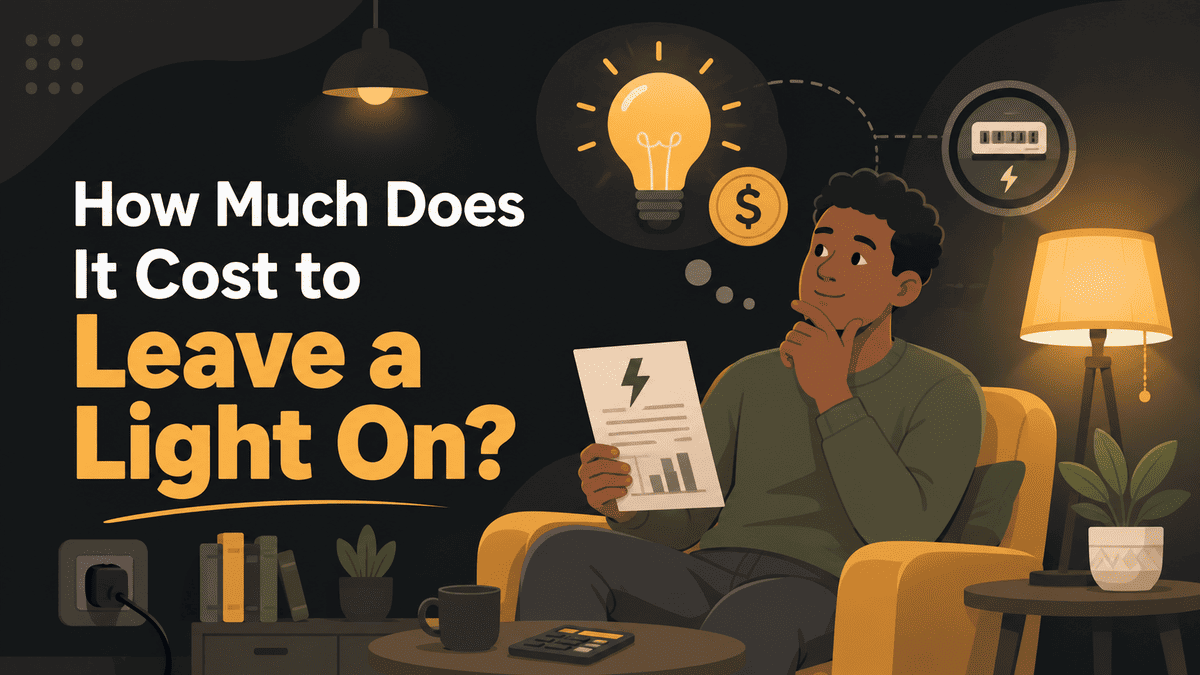
Replacing incandescent bulbs with LEDs yields substantial, long-term savings.Leaving a typical LED light on costs about 4 cents for a full 24 hours, or roughly $1.20 a month if you never switch it off, at the 2026 US average electricity rate of about $0.18 per kWh. An old 60 watt incandescent bulb doing the same job costs around $7 a month, roughly six times more. In short: with LED bulbs, leaving a light on barely registers on your bill. With incandescents, it adds up. The bulb you use matters far more than whether you flip the switch.
Quick facts: cost of leaving a light on
| Detail | Figure |
|---|---|
| 9W LED per hour | About 0.16 cents |
| 9W LED for 24 hours | About 4 cents |
| 9W LED left on all month | About $1.20 |
| 60W incandescent all month | About $7 |
| 2026 US average electricity rate | About $0.16 to $0.18 per kWh |
| Share of a home’s electric bill | Lighting is roughly 8 to 15 percent |
How much does it cost to run a light bulb?
The cost comes down to one thing: wattage. A modern LED bulb that produces the same brightness as an old 60 watt incandescent uses only about 9 to 10 watts, so it costs a fraction as much to run.
| Bulb | Watts | Per hour | Per 8 hours | Per month (8 hrs/day) |
|---|---|---|---|---|
| LED (60W equivalent) | 9 W | About 0.16 cents | About 1.3 cents | About $0.40 |
| Halogen | 43 W | About 0.8 cents | About 6 cents | About $1.85 |
| Incandescent | 60 W | About 1.1 cents | About 8 cents | About $2.60 |
A 60 watt incandescent produces about 800 lumens of light. A 9 watt LED produces the same 800 lumens using less than a sixth of the power. The extra energy an incandescent draws is not doing useful work, it comes out as heat, which is why old bulbs got hot enough to burn and why they added to summer cooling costs.
How much to leave a light on all day or overnight
| Duration | 9W LED | 60W incandescent |
|---|---|---|
| 1 hour | About 0.16 cents | About 1.1 cents |
| 8 hours (overnight) | About 1.3 cents | About 8 cents |
| 24 hours | About 4 cents | About 26 cents |
| A full month, 24/7 | About $1.20 | About $7 |
| A full year, 24/7 | About $14.85 | About $95 to $99 |
A single LED left on around the clock for a whole year costs under $15. A single incandescent left on the same way costs close to $100. That is the number that surprises most people, and it is per bulb, so a house full of forgotten incandescents is where the real waste lives.
The formula to work out your own cost
Lighting uses the same formula as every appliance:
(Watts divided by 1,000) x hours used x your rate per kWh = cost
So a 9 watt LED left on 24 hours at $0.18 per kWh costs (9 / 1000) x 24 x 0.18, which is about 4 cents a day. For several bulbs, add their wattages together first. Our appliance electricity cost calculator does the maths, and our guide on what a kilowatt-hour is explains the unit your bill charges by.
Does turning lights on and off use more electricity?
No. This is a common myth. The startup surge for an LED or incandescent bulb lasts only milliseconds and uses about the same energy as a few seconds of normal running. There is no financial reason to leave a light on rather than switch it off, so for LEDs and incandescents, turn them off whenever you leave a room.
The old advice about leaving lights on applied only to CFL bulbs, and even then it was about extending bulb life, not saving energy. Since CFLs are being phased out for LEDs, that guidance is now largely irrelevant.
What matters more than switching off: the bulb
Here is the honest takeaway. In an all-LED home, being diligent about switching off lights saves only about $1 to $5 a month, because LEDs are already so cheap to run. The bigger saving is a one-time hardware change: replacing incandescent bulbs with LEDs permanently cuts the cost whether the light is on or off.
Replacing a single 60 watt incandescent used four hours a day with a 9 watt LED saves about $14 a year. Across a whole house of 40-plus bulbs, and especially in high-rate states, that adds up to real money. In the highest-rate states, a house still running incandescents can spend hundreds more a year on lighting than the same house on LEDs.
And lighting is only a small slice of the bill in the first place, about 8 to 15 percent, while heating and cooling are 40 to 50 percent. If you want to save real money, the thermostat matters far more than the light switch. Our guides on why your electric bill is so high and how to lower your electric bill show where the big savings actually are.
FAQ
How much does it cost to leave a light on all day?
An LED bulb left on for 24 hours costs about 4 cents, or roughly $1.20 a month if left on continuously. A 60 watt incandescent doing the same costs about 26 cents a day, or around $7 a month.
How much does it cost to run a light bulb per hour?
A 9 watt LED costs about 0.16 cents an hour at the 2026 average rate. A 60 watt incandescent costs about 1.1 cents an hour, roughly seven times more for the same brightness.
Is it cheaper to leave a light on or turn it off?
It is always cheaper to turn it off. The startup surge is negligible for LED and incandescent bulbs, so there is no energy penalty for switching them on and off as often as you like.
Do LED bulbs really save money?
Yes. An LED uses about a sixth of the power of an incandescent for the same light, saving roughly $14 a year per bulb replaced at typical use. Across a whole home the savings are substantial, especially in high-rate areas.
How much of my electric bill is lighting?
Lighting is usually about 8 to 15 percent of a home’s electricity use. Heating and cooling are far larger, at 40 to 50 percent, so that is where the biggest savings are found.
Disclaimer: This article is general information, not financial advice. Electricity rates, bulb wattages and usage vary, so figures are 2026 US averages for guidance only. Check your bulb’s wattage and your electricity bill’s per-kWh rate for an accurate estimate.