

Key Moments
Essential Equipment
Use a four-wheel piano dolly, lifting straps, ratchet straps, and thick moving blankets for safe moving.Upright Piano Moving Steps
Measure the route, protect the piano, lift with a team, roll slowly, and load securely.Grand Piano Handling
Disassemble parts, use a padded skid board, and recognize it as a specialist move.When to Hire Professionals
Hire pros for stairs, tight spaces, large teams needed, lacking proper gear, or moving grands any distance.A piano is one of the hardest things in a home to move. An upright weighs roughly 300 to 500 pounds, and some larger ones approach 900, while grand pianos run from about 500 to 1,200 pounds. They are heavy, top-heavy, fragile inside, and unforgiving if they tip. This guide walks through how to move one safely, but it opens with an honest point: for many people, hiring a professional is the smarter call, and we will cover when that is true.
Quick facts: moving a piano
| Detail | Typical figure |
|---|---|
| Upright weight | About 300 to 500 lbs (some up to 900) |
| Grand weight | About 500 to 1,200 lbs |
| Crew needed | 3 to 4 people minimum, more for grands or stairs |
| Local pro move | Roughly $150 to $1,000 |
| Long-distance pro move | Roughly $700 to $2,000 |
| Tuning after the move | $100 to $200, after a 2 to 4 week wait |
Cost figures are estimates and vary with distance, stairs, and access.
Equipment you need
Do not attempt a piano move without the right gear. The baseline kit is not optional:

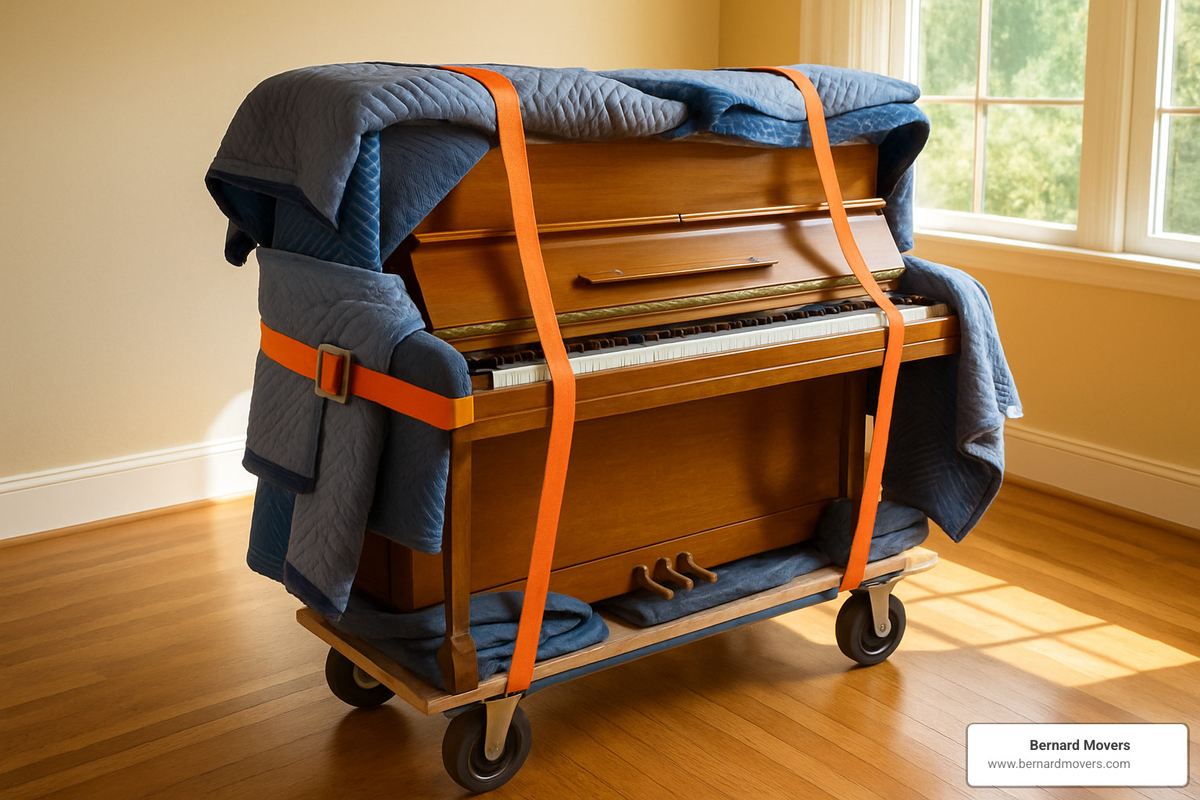
- A four-wheel piano dolly rated for the weight. The piano’s own casters are not moving equipment; they can stick, tear flooring, and fail.
- Lifting straps to take the load off your back and give you control.
- Ratchet (tie-down) straps to secure the piano to the dolly and inside the truck.
- Thick moving blankets (at least a quarter inch) to wrap and protect the case.
- For a grand piano, a padded skid board, plus tools to remove the legs, lyre, and pedals.
Renting this gear typically runs about $50 to $150 for the day. Buying it outright can cost $300 to $500, which only makes sense if you move pianos regularly.
How to move an upright piano, step by step
1. Measure the entire route. Every doorway, hallway width, and stair clearance, at both homes and into the truck. Knowing it fits before you lift saves a disaster mid-move.
2. Clear and protect the path. Remove obstacles, breakables, and anything that could be knocked over. Lay down floor runners if you have them.
3. Secure and protect the piano. Close and tape the keyboard lid (fallboard) and the top lid. Pad the pedals. Drape moving blankets over all four sides and secure them with straps, not tape on the wood, which can pull off the finish.
4. Lift with a team of at least four. Two people bear the weight from the sides, never by the legs, while a third slides the dolly underneath and a fourth guides. Bend your knees, keep the piano upright, and allow only small tilts. Big tilts are how uprights crack at the leg joints.
5. Roll slowly and communicate. Once on the dolly and strapped down, move in small increments. Call out every obstacle. If it starts to lean, stop and reset rather than fight it.
6. Load against the truck wall and tie it down securely with ratchet straps so it cannot shift in transit.
Grand pianos are a different job
A grand should be partially disassembled. Lower and secure the lid, then remove the lyre (pedal assembly), legs, and music rack, wrapping each piece separately. With helpers supporting the body, tilt it onto a padded skid board, strap it down, and move the whole assembly on dollies. This is genuinely a specialist task, and moving a grand off-property is usually not a DIY job.
When to hire a professional
Treat these as safety limits, not judgment calls. Hire pros if:
- There are stairs, even a few. Stairs roughly double the strength required and are the highest-risk piano scenario.
- The path is tight, with narrow doorways or blind turns.
- You cannot gather enough strong, calm helpers (three to four for an upright, more for a grand).
- You do not have the proper dolly, straps, and blankets.
- It is a grand piano moving any meaningful distance.
The math is simple. One DIY mover put it bluntly after a failed attempt: what looked like a $400 saving turned into thousands in repairs and an ER visit. Professional piano movers carry the experience, equipment, and insurance that make the difference, and specialty handling like this is exactly the kind of move where a generous tip is appropriate. See how much to tip movers for specialty-item norms.
After the move: tuning
Any piano detunes after a move because the soundboard reacts to vibration, temperature, and humidity. Let it acclimate to the new room for two to four weeks, then book a registered technician. Budget $100 to $200 for the tuning.
Frequently asked questions
How many people does it take to move a piano? At least three to four for an upright, and five or six for a heavy upright or a grand. Fewer than that is unsafe given how the weight shifts once a piano starts to tip.
Can you lay a piano on its back to move it? No, not an upright. Laying it on its back can cause serious internal damage to the soundboard and action. Keep uprights upright, with only small tilts.
How much does it cost to hire piano movers? A local piano move typically runs $150 to $1,000, and a long-distance move $700 to $2,000, depending on the piano, stairs, and access. Get a few quotes.
Do I need to tune my piano after moving it? Yes. Wait two to four weeks for it to settle into the new environment, then have a technician tune it. Plan on $100 to $200.
The bottom line
Moving a piano is less about muscle and more about judgment and the right equipment. Measure the route, protect the instrument, use a proper dolly and a team of at least four, and move slowly. But be honest about stairs, tight turns, and grands, because those are the moments when hiring a professional is the safer and often cheaper choice.
For other tricky items and the full process, see how to move a mattress, how to pack for a move, and our complete guide to moving.
This article is for general informational purposes only. Moving heavy instruments carries real risk of injury and damage. When in doubt, hire insured professional piano movers.