

Key Moments
Choose Your Move Method
Select full-service movers, moving containers, or DIY truck rental based on budget and effort.Start Planning Early
Begin planning about eight weeks ahead to smooth the process and spread out tasks.Efficient Packing Strategies
Pack in order of least use, label boxes clearly, and handle special items with care.Settle In Smartly
Focus on essentials first like utilities and safety checks during the first week in your new home.Moving is one of life’s genuinely stressful events, but almost all of that stress comes from the same place: too many decisions and tasks landing at once, near the end. This guide lays out the entire move in order, from the first decision about how to move to the last box unpacked, so you always know what comes next. Think of it as the map. Each section links to a detailed guide when you need to go deeper.
The five phases of any move
| Phase | What it covers |
|---|---|
| 1. Decide and budget | How you will move and what it will cost |
| 2. Plan and declutter | A timeline and lightening the load |
| 3. Pack | Supplies, order, and protecting your things |
| 4. Moving day | Loading, transport, and the handover |
| 5. Settle in | Unpacking, utilities, and updating records |
Phase 1: Decide how you will move and set a budget
Every other decision flows from this one. There are three broad ways to move:
- Full-service movers do the most and cost the most. Best for large homes, long distances, or anyone who wants the least stress.
- Moving containers are the middle ground. A company drops a container, you load it on your schedule, and they transport it.
- DIY truck rental is usually the cheapest, in exchange for your time, effort, and the driving.
The right choice depends on your budget, distance, and how much work you want to take on. Costs vary widely: a local move typically runs $550 to $2,500, while a long-distance move runs $1,500 to $8,500 or more. Our full breakdown is in how much do movers cost, with detailed guides for local moving cost and long distance moving cost. To estimate your own number, use the moving cost calculator.

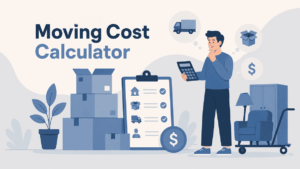
Build your budget around more than the movers: supplies, insurance, a tip, and possibly storage. If you hire movers, factor in a tip for good service, covered in how much to tip movers.
Phase 2: Plan the timeline and declutter
The single best thing you can do for a smooth move is start early and spread the work out. About eight weeks is ideal. Our moving checklist lays out the whole timeline week by week, but the headline beats are:
- 8 weeks out: decide your method, set the budget, give notice if renting, and start decluttering.
- 6 weeks out: gather supplies, request records, begin packing rarely-used items.
- 4 weeks out: book movers, notify everyone, change your address.
- 2 weeks out: pack in earnest and confirm details.
Decluttering is the highest-value task here. Every item you do not move saves hours on a local job and weight on a long-distance one. Sell, donate, or toss before you pack a single box.
Phase 3: Pack with a system
Packing is the most time-consuming part of moving and where most breakage happens when it is rushed. The system is simple: start early, pack in order of how little you use things, and label everything by room and contents. Heavy items go in small boxes, light items in large ones.
Our how to pack for a move guide walks through it room by room. You do not need to buy all your boxes either, see where to get free moving boxes for reliable free sources.
Some items need their own approach. A piano and a mattress each have specific methods (and specific ways to ruin them), so handle those with care.
Phase 4: Moving day
By moving day, the goal is execution, not decisions. Keep an essentials bag with you (documents, medications, chargers, toiletries, a change of clothes) rather than on the truck. Then:
- Do a quick walkthrough of the new home before unloading to confirm it is clean and ready.
- Be present to direct movers and check items off your inventory.
- Confirm utilities are working, especially water and power.
- Do a final sweep of the old home and hand over the keys.
If your move-out and move-in dates do not line up, you may need storage to bridge the gap. The options and costs are in moving and storage.
Phase 5: Settle into your new home
The first week is about getting the essentials working, not finishing everything. Unpack room by room starting with the kitchen and bedrooms, test smoke and carbon monoxide detectors, and locate the main shutoffs. Our new home moving checklist covers the before, during, and after of move-in.
Do not forget the paperwork. File your change of address and update every account before mail forwarding ends, the change of address checklist lists everyone to notify.
Special situations
Some moves have an extra layer:
- Moving out of state. Interstate moves add driver’s license, registration, voter, and tax steps on top of the usual logistics. See the moving out of state checklist.
- Moving out for the first time. If you are leaving home young, the challenge is as much financial as logistical. Our how to move out at 18 guide covers budgeting, deposits, and first-apartment realities.
How to make any move less stressful
A few principles carry through every move:
- Start early. Almost all moving stress comes from compressing everything into the final days.
- Declutter hard. Less stuff means a cheaper, faster, easier move.
- Get organized. A budget, a timeline, and labeled boxes do most of the work.
- Get three quotes if you are hiring, and compare them itemized.
- Protect what matters. Keep documents and valuables with you, and insure anything fragile or expensive.
Frequently asked questions
How far in advance should I start planning a move? About eight weeks for a smooth move, and earlier for a long-distance one. That gives you time to budget, declutter, book movers, and notify everyone without a last-minute rush.
What is the cheapest way to move? A DIY truck rental for a decluttered load, packed yourself with free boxes, on an off-peak weekday. A moving container is a convenient middle ground that often beats full-service movers on price.
What should I do first when planning a move? Decide how you will move (full-service, container, or DIY) and set a budget. Then start decluttering. Those decisions shape everything else.
How much does it cost to move? A local move typically runs $550 to $2,500, and a long-distance move $1,500 to $8,500 or more, depending on home size, distance, season, and services.
The bottom line
Moving is manageable when you treat it as five phases instead of one overwhelming event: decide and budget, plan and declutter, pack, execute moving day, and settle in. Start early, lighten your load, stay organized, and lean on the detailed guides linked throughout for each step. Do that, and the move that felt daunting becomes a series of small, doable tasks.
Ready to dig into a specific step? Start with the moving checklist to map your timeline, how much do movers cost to set your budget, and how to pack for a move when it is time to box everything up.
This article is for general informational purposes only. Moving costs and requirements vary by location, season, and situation. Always obtain personalized quotes and confirm any official requirements before your move.