


Key Moments
Know Your Mattress Type
Understand if your mattress is innerspring, hybrid, memory foam, or latex to handle it correctly without damage.Essential Moving Supplies
Use a heavy-duty mattress bag, tie-down straps, a dolly, and a helper for a smooth move.Proper Carrying Technique
Carry the mattress on its side with at least two people and reinforce if floppy for safer handling.Transport and Storage Tips
Lay the mattress flat during transport when possible, secure it well, and store flat sealed without weight on top.A mattress looks easy to move and then fights you at every doorway. It is heavy, floppy, awkward to grip, and easy to stain or bend out of shape if you handle it wrong. The good news is that a clean, undamaged move comes down to a few cheap supplies and knowing what not to do, especially with the type of mattress you own.
Quick facts: moving a mattress
| Detail | What to know |
|---|---|
| Mattress weight | About 50 to 150 lbs by size |
| Must-have supply | A heavy-duty mattress bag |
| People needed | At least 2 for anything queen-size or larger |
| Memory foam / latex | Can roll or briefly fold, but transport flat |
| Innerspring / hybrid | Never fold; it damages the coils |
| Local pro move | Roughly $50 to $100 |
What you need
- A mattress bag sized to your mattress (measure the depth too). It shields against dust, moisture, and tears, and it is the single most useful item. Tape it closed so the mattress cannot slide out.
- Tie-down straps or rope to carry and to secure it in the vehicle.
- A dolly, if you have one, to save your back.
- A helper. Moving a mattress solo is possible for smaller sizes, but a second pair of hands makes it far safer.
- A suitable vehicle. A moving truck is best. A pickup or van works. A car roof is a last resort and a risky one.
The one rule that depends on your mattress type
Before you bend or fold anything, know what you own, because this is where mattresses get ruined:
- Innerspring and hybrid mattresses must not be folded. The coils can kink and never recover, leaving the mattress lumpy. Keep these flat or on their side only.
- Memory foam and latex are more forgiving and can be rolled, or folded briefly, for transport. Even so, the safest approach is to keep them flat in the vehicle and only fold or roll if space forces it and the manufacturer allows it. Foam left folded too long can lose its shape.
When in doubt, check the manufacturer’s guidance. Treating a spring mattress like foam is the most common way people destroy a perfectly good bed during a move.

How to move a mattress, step by step
1. Strip and clean it. Remove all bedding. Give the mattress a quick vacuum so you are not sealing dust inside the bag.
2. Bag and seal it. Lay it flat, slide it into the mattress bag, and tape the bag closed. If you do not have a bag, wrap it tightly in plastic or a tarp and tape it well.
3. Clear the path. Prop doors open and remove obstacles, lamps, and breakables along the whole route from bedroom to vehicle.
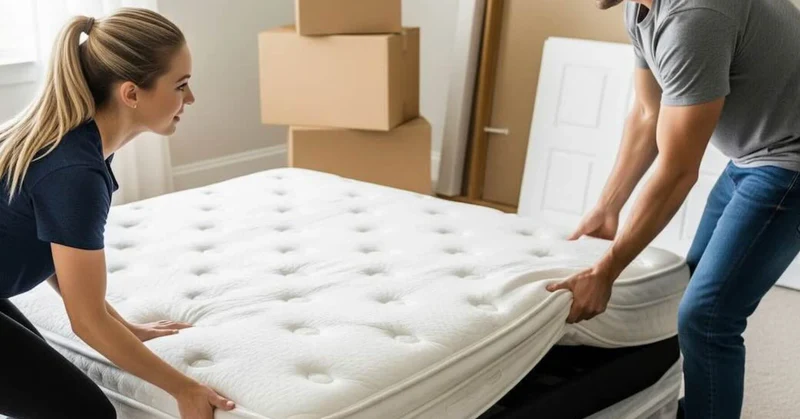
4. Carry it on its side. A mattress is much easier to maneuver through doorways and tight spaces standing on its edge than carried flat. With one person at each end, walk it out slowly. Lift with your legs, not your back.
5. Reinforce a floppy mattress if needed. For a large queen or king that bends too much to carry, flatten large cardboard boxes against each side and strap them on for rigidity.
6. Load and secure it. Lay it flat in the truck if there is room, which is gentlest on the materials, or stand it on its side against a wall in a tight load. Secure it with straps so it cannot slide, and never put heavy items on top of it.
If your move-in is delayed and the mattress needs to sit for a while in between, store it flat, sealed in its bag, with nothing on top. Storing it folded or on its side long-term can permanently distort it. Our guide to moving and storage covers bridging that gap.
A note on compressing a memory foam mattress
You can buy or rig a vacuum bag to compress a memory foam mattress the way it shipped from the factory, using a shop vac to pull the air out, then rolling and strapping it. It makes transport much easier, but be aware that DIY compression can put uneven pressure on the foam and may affect its support or shape. Treat it as a short-term moving trick, not a storage method, and never compress an innerspring or hybrid.
Frequently asked questions
Can you fold a mattress to move it? Memory foam and latex can be folded or rolled briefly. Innerspring and hybrid mattresses should never be folded, because it can permanently damage the coils. When unsure, keep it flat.
Do I need a mattress bag? It is strongly recommended. Moving trucks are dusty, and you may have to set the mattress on the ground. A bag protects it from dirt, moisture, and tears for a few dollars.
How do you move a mattress by yourself? Bag it, clear the path, and stand it on its side to walk it out. Reinforcing a large mattress with cardboard on each side makes it rigid enough to handle alone, though a helper is safer.
Should a mattress be transported flat or on its side? Flat is gentlest on the materials, especially for foam. On its side is fine for shorter trips and tight loads, as long as it is secured and nothing presses against it.
The bottom line
Bag it, clear the path, carry it on its side, and match your method to your mattress type, never folding a spring or hybrid. Lay it flat in the vehicle when you can, secure it, and keep weight off it. Do that and your mattress arrives clean, supported, and ready for the first night in your new home.
For other awkward items and the full process, see how to move a piano, grab supplies via where to get free moving boxes, and start with our complete guide to moving.
This article is for general informational purposes only. Always follow your mattress manufacturer’s guidance on folding, rolling, and storage to avoid voiding any warranty.